

A discharge order arrives in the mail, and the first thing a lot of homeowners do is call a real estate agent. Usually, that call comes two to six weeks early. Chapter 7 bankruptcy wipes out your personal liability for most unsecured debts. Discharge prints without the court file closing on the same day. The house belongs to the bankruptcy estate until something specific happens to release it. I’ve walked dozens of sellers through this gap. Knowing where you sit in the case saves you from signing a contract you can’t legally close.
What Happens During the Chapter 7 Bankruptcy Process?
Filing for Chapter 7 bankruptcy feels like pressing a reset button on everything you owe. Then the paperwork starts, and you find out you’ve handed temporary control of your property to someone you’ve never met.
When you file a bankruptcy petition under Chapter 7 of the Bankruptcy Code, nearly everything you own drops into a legal container called the bankruptcy estate. The house goes in with it. A court-appointed trustee takes the wheel on anything the estate holds, so you keep living in the home, paying the mortgage, mowing the lawn, all of it. Ownership on paper doesn’t change hands. Control does.
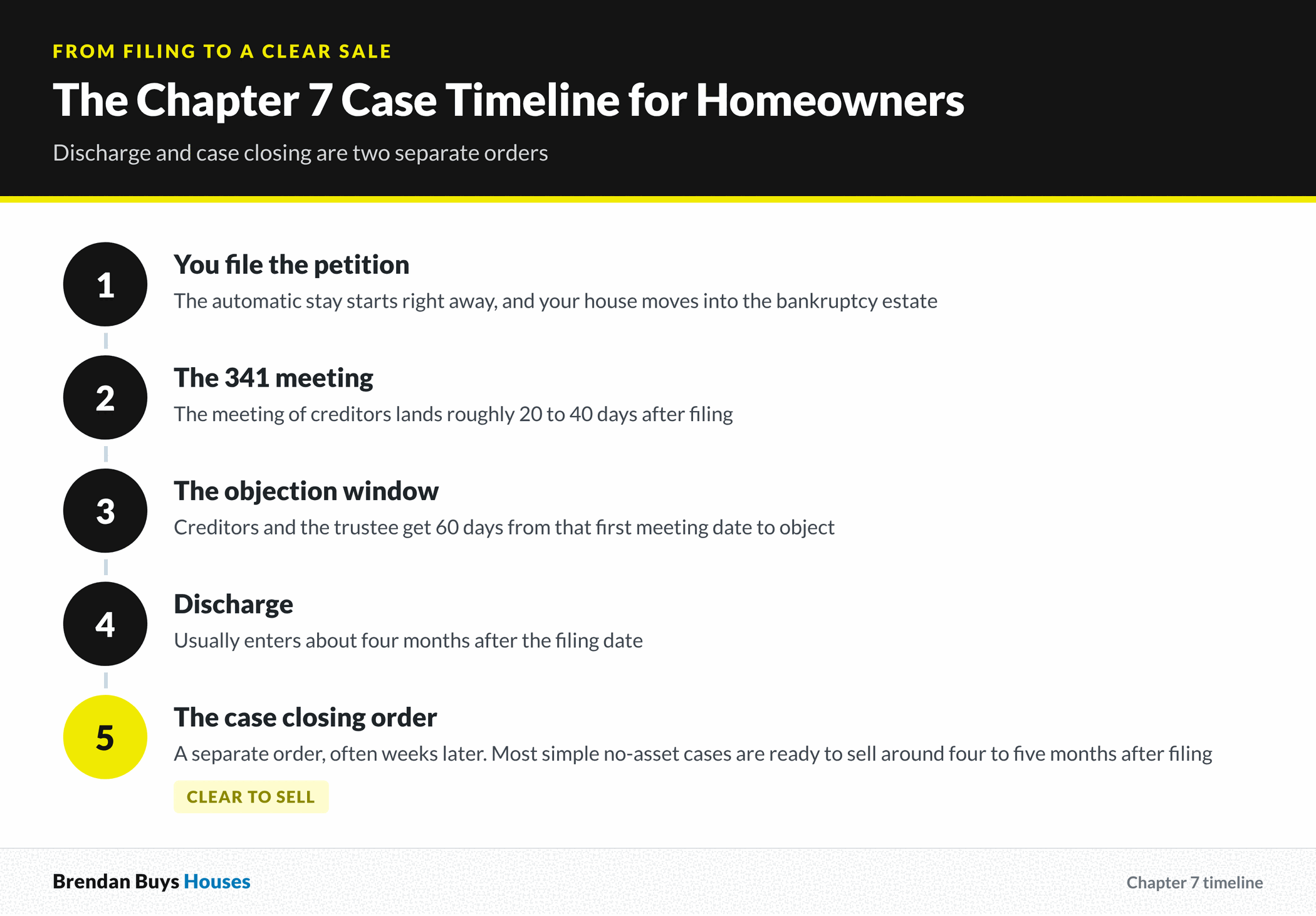
Compared to typical federal court cases, this schedule moves faster. The meeting of creditors, the one everyone calls the 341 meeting, lands roughly 20 to 40 days after you file the petition. Creditors and the trustee then get 60 days from that first scheduled meeting date to object to your discharge or move to dismiss the case. Once those windows expire with nothing pending, the discharge usually enters about four months after the filing date, according to the federal courts’ own guidance.
Filing also triggers the automatic stay the moment your petition hits the clerk’s desk, so scheduled foreclosure sales get postponed and pending judicial foreclosure cases pause. Protection is why so many homeowners file in the first place.
Plenty of households are in this exact spot. In the 12 months ending with the second quarter of 2026, Chapter 7 filings ran 14.7% above the same stretch a year earlier. This tells you how many people are working through this exact situation right now.
What Does the Case Trustee Do with Your Property in Chapter 7 Bankruptcy?
A rental property worth $60,000 more than its mortgage is exactly what catches a trustee’s attention. For years I assumed a trustee was mostly a referee who showed up at one meeting and disappeared. Wrong. Finding value for creditors is the trustee’s whole job, and a house with equity is the most obvious place to look.
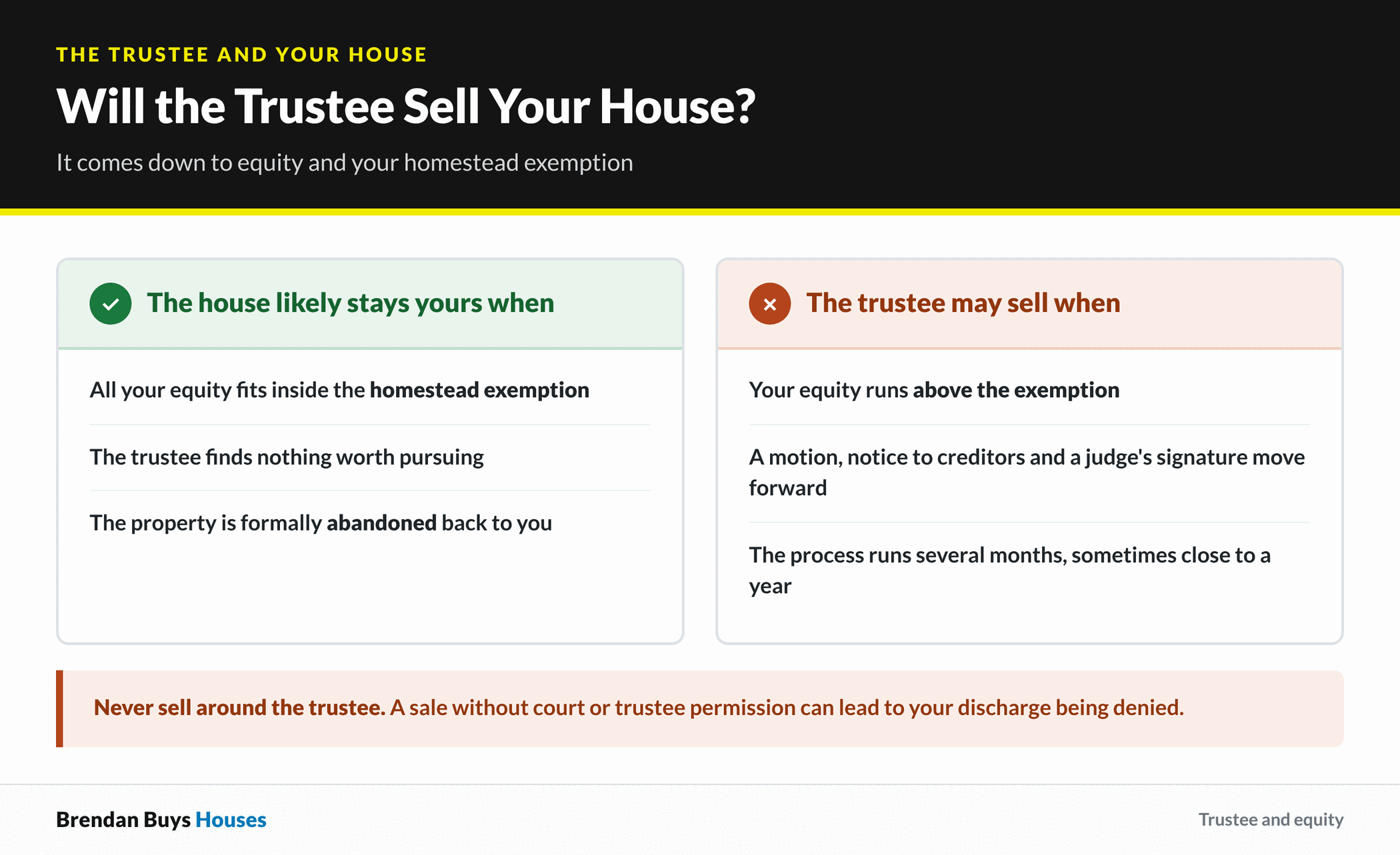
Your homestead exemption is what stands between the trustee and your home. Every state sets its own amount, and the spread between states is enormous; some protect a modest slice of equity, others protect the whole property. If your equity falls entirely inside that exemption, the trustee has no legal authority to sell the home, so you’re in the clear. Equity above the line is a different story. That surplus is money the trustee can collect for creditors, and the house becomes a target.
What happens when the trustee decides there’s nothing worth pursuing? The property gets abandoned, formally, back to you, which means control is yours again. Once the trustee has abandoned any interest in the property, the house is yours to sell.
A trustee-run sale takes a motion filed with the bankruptcy court, notice to creditors, and a judge’s signature. When a trustee confirms non-exempt equity exists, the full process from motion to closing can run several months and sometimes close to a year.
Do not try to work around this during Chapter 7 bankruptcy. A sale attempted without court or trustee permission is improper and can lead to your discharge being denied. Losing the discharge means the debt relief you filed for evaporates while the house still sells. I’ve had sellers push back on how slow the court moves, and I understand the frustration, but no closing is worth that trade.
How Does a Chapter 7 Bankruptcy Discharge Affect Your House?
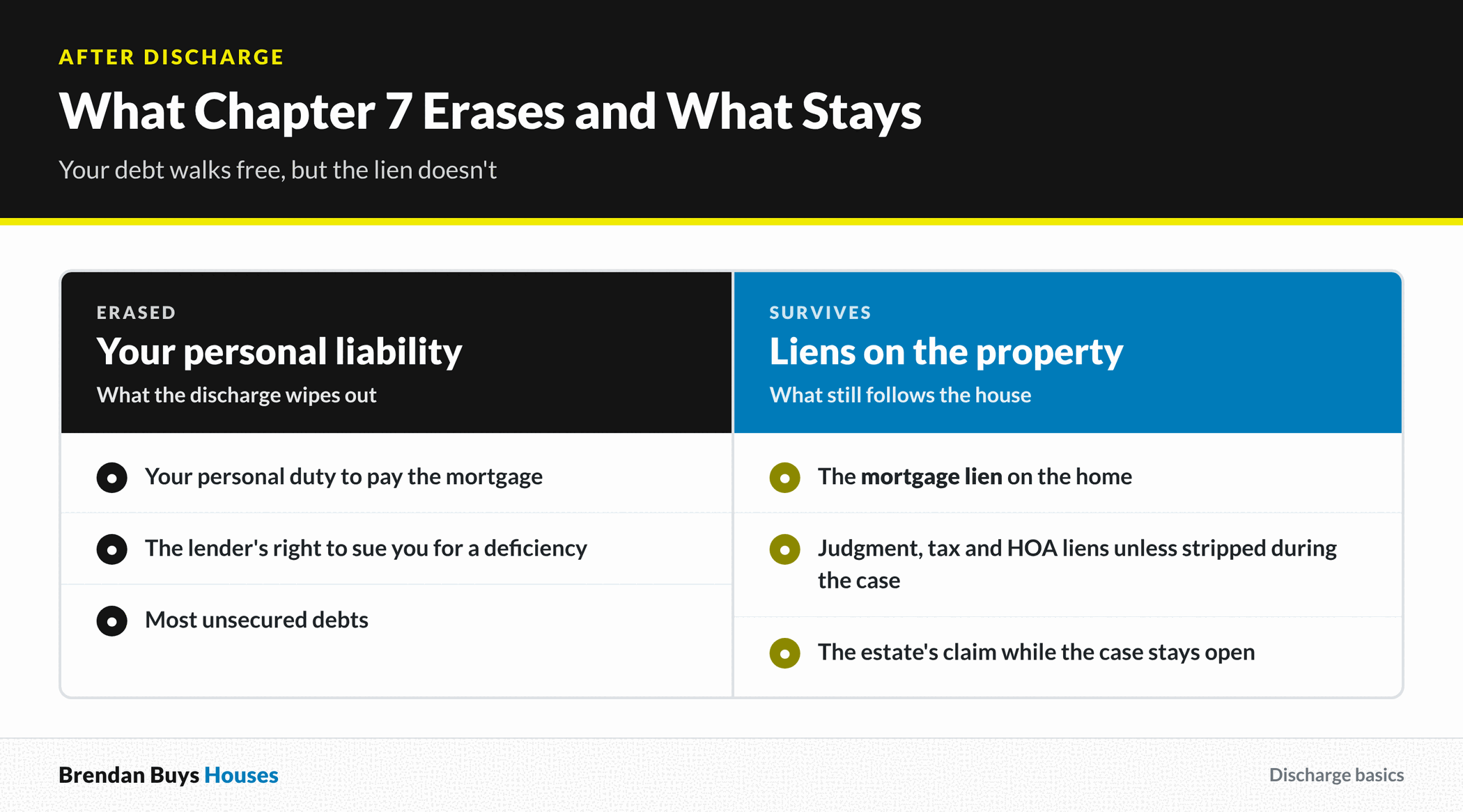
Your house doesn’t just walk free because your debt does. The discharge erases your personal obligation to pay the mortgage, but it doesn’t erase the mortgage lien on your property. Those are two different things, and the difference decides whether you can sell.
You still own the home after Chapter 7 bankruptcy, and the bank’s lien survives the case. So the lender can’t sue you for a deficiency, but it can still foreclose on the collateral if payments stop. Any judgment liens, tax liens, or HOA liens recorded against the property follow the same logic unless they were stripped or avoided during the case. At closing, a title company pays off every one of them from your proceeds.
One detail trips up timing: the discharge order is not the case closing order. Two separate documents, often weeks apart. Your discharge doesn’t automatically close the case or pull the property out of the bankruptcy estate, and the trustee keeps the power to sell non-exempt property while the case stays open for asset administration.
I still think about a family outside Concord, New Hampshire, who learned this the expensive way last year. They watched two agent listings expire with zero offers across eight months, mostly because their case was still open and buyers’ lenders kept backing out at underwriting. The garage was packed with a half-finished bathroom remodel nobody wanted to inherit. By the time they called me, they’d lost a full selling season.
Ask your attorney for the docket entry showing the case was closed. That one sentence protects you more than any advice I can give.
What Should You Do Once Your Chapter 7 Bankruptcy Case Settles?
A seller called me on a Thursday, holding a discharge order she’d received five weeks earlier and a buyer’s offer expiring Monday. Nobody had told her the trustee was still administering a rental property in the same case, which kept everything open.
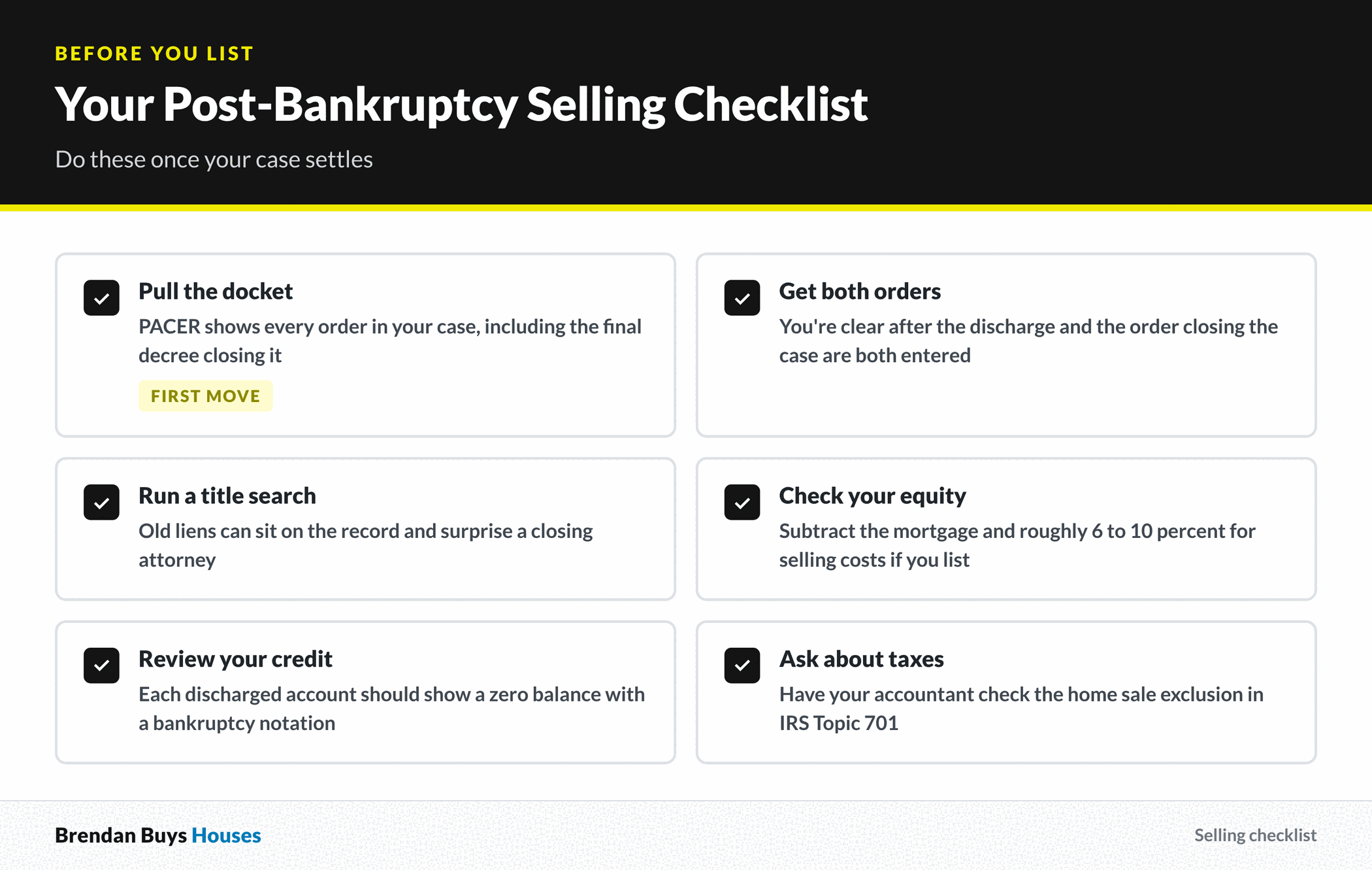
First move: pull the docket. PACER shows you every order entered in your case, including the final decree closing it. Your bankruptcy attorney can pull it in about ninety seconds and tell you plainly whether the estate still has a claim on the house.
Second, get your title examined before you list. Bankruptcy doesn’t clean up a title by itself, so old liens sometimes sit there, recorded, waiting to surprise a closing attorney. A title search costs very little compared to a contract that dies in escrow.
Third, look hard at your actual equity position. Order a market valuation, subtract the mortgage balance, subtract roughly 6 to 10 percent for selling costs if you go the traditional route, and see what’s left. Most of that cost is agent commission. Would the number still work for you after repairs?
Credit repair starts here too, quietly. Pull your reports and confirm that every discharged account reports a zero balance with a bankruptcy notation. Errors are common, and nobody fixes them for you.
A quick note on taxes, because sellers ask constantly: the IRS allows a capital gains exclusion on the sale of a primary residence if you meet ownership and use requirements. Chapter 7 bankruptcy doesn’t disqualify you from it. The specifics live in IRS Topic 701, and your accountant should run your numbers before you sign anything.
Can You Sell Your House Right After Chapter 7 Bankruptcy Discharge?
Across a kitchen table, I’d put it plainly: if your case is closed and the trustee walked away from the house, you can list it tomorrow. Nothing about the bankruptcy stands in your way.
You can sell your house the day after your Chapter 7 discharge enters, assuming the property is out of the estate. After discharge, with the estate wrapped up, you sell freely without court involvement. No waiting period exists in the Bankruptcy Code, and there’s no seasoning requirement either. The federal bankruptcy laws don’t impose a cooling-off period on sellers the way mortgage lenders impose one on borrowers.
The trouble comes when the case is still open. Selling an asset during an open Chapter 7 case without the trustee’s approval isn’t allowed; the trustee signs off first, then the bankruptcy court approves the sale terms before closing. Any purchase contract in that situation needs a contingency stating the sale is subject to bankruptcy court approval.
I’d push back on one piece of advice floating around out there, which is that getting the discharge means you’re clear. It doesn’t. You’re safe to sell after the discharge has been entered and an order closing your case has also been entered. Two orders, not one.
Can a cash buyer skip the court step during an open case? No; the same motion, approval, and proceeds rules apply no matter who’s buying.
How Soon After Chapter 7 Can I Sell My House?
There’s no fixed timeline here, and anyone who tells you otherwise hasn’t handled enough of these cases. “My attorney said four months, so why am I still waiting?” I hear that one a lot. The answer is that four months describes the typical path to discharge, not the path to a clear sale. Add the closing order, and most straightforward no-asset cases put you in position to sell somewhere around four to five months after filing.
Cases with non-exempt equity run longer, because the trustee has to finish administering that asset before anything closes. Selling during Chapter 7 bankruptcy is possible with court approval on a motion to sell, so you’re not frozen; you’re just on the court’s calendar instead of your own.
Layer the market on top of that timeline. In October 2026, the median U.S. sale price was $388,634, down 0.35% from a year earlier, with homes taking a median 50 days to go under contract. Homes also sold at about 98.3% of their list price, with 4.3 months of supply on hand. Add 30 to 45 days for a financed buyer’s closing, and a traditional listing started the week your case closes realistically funds about three months later.
Run the arithmetic for your own situation. If your case closes in February and you list in March, you’re looking at money in hand around June, assuming no inspection drama and no appraisal gap.
That timeline works fine for some sellers and not at all for others. Homeowners facing a reinstated foreclosure, a job relocation, or a mortgage they can no longer carry don’t have three months to spend. For those situations, a direct sale to a local buyer like Brendan Buys Houses compresses the back half of that timeline, since there’s no lender underwriting involved.
What Are Your Options for Selling a House After Chapter 7 Bankruptcy?

The right option depends mostly on how much equity survived the case and how much time you’ve got.
Listing with an agent makes sense when you have real equity, a home in decent shape, and patience. You’ll typically net the highest gross price this way. Against that, weigh commission, repairs the inspector will find, holding costs while the house sits, and the chance a buyer’s financing collapses.
Selling as-is to a direct buyer trades some price for certainty and speed. No repairs, no showings, no appraisal contingency, and you pick the closing date. Sellers with limited equity often come out similar on net proceeds once commission and repair credits are subtracted from the listed price.
A short sale enters the picture when you owe more than the house is worth, so your lender has to approve the payoff shortfall, and that approval takes time. After Chapter 7 bankruptcy, the discharged deficiency usually isn’t chasing you, which removes much of the pressure that makes short sales miserable.
Then there’s the option nobody names out loud: keep the house. If the mortgage is current and the payment fits your post-bankruptcy budget, staying put’s a legitimate answer. I’ve told sellers to keep their homes more than once, and I’ve never regretted it.
An heir in Portland, Maine, came to me in the middle of a divorce, splitting assets he’d inherited and finished with the whole subject. He didn’t want a listing, a sign in the yard, or a conversation about paint colors. He wanted a date on a calendar and a wire transfer. The back deck that needed replacing was never going to get replaced by either party. We closed on his timeline and he never set foot in the house again. If that sounds like your situation, the team at Brendan Buys Houses handles these quietly and without the theater.
Frequently Asked Questions
Most of what you’ve read online about life after bankruptcy is too pessimistic.
Can You Reach a 700 Credit Score After Chapter 7 Bankruptcy?
Yes, and faster than the horror stories suggest. Filers who open a secured card, pay every bill on time, and keep balances low often cross into the 700s within two to four years. Payment history and utilization carry far more weight than the public record. The filing itself stays on your report for several years, but its scoring impact fades steadily. Verify that every discharged account reports a zero balance, since reporting errors hold scores down more than the bankruptcy does.
What Are the Drawbacks of Filing Chapter 7 Bankruptcy?
The trustee can sell property that isn’t protected by an exemption, which is the big one for homeowners with substantial equity. Not every debt disappears either; most student loans, recent taxes, child support, and alimony survive the case. Future credit costs more for a while, and mortgage lenders impose their own waiting periods before they’ll approve you again. Those tradeoffs still beat the alternative for a lot of households, but you want an attorney pricing them out for your specific situation.
Will Filing Chapter 7 Bankruptcy Stop a Foreclosure Sale?
It stops it immediately, because the automatic stay takes effect the second your petition is filed, and a sale held in violation of it is generally void. What the stay doesn’t do is cancel the debt secured by your house. Your lender can ask the court to lift the stay and resume foreclosure, and once your case closes, nothing prevents foreclosure if the loan stays unpaid. Filing buys you time to sell, catch up, or arrange something else.
Do You Need Court Permission to Sell During Chapter 7 Bankruptcy?
While your case is open and the home remains estate property, yes. Your trustee has to approve the sale, and the bankruptcy court has to sign off on the terms before you can close. That’s why any contract signed during an open case should be conditioned on that approval. Once the trustee abandons the property or the court enters the order closing your case, the permission requirement goes away and you sell like any other owner.
Does Chapter 7 Bankruptcy Affect How Much You Can Sell For?
Not one dollar. Buyers pay for houses, not credit histories, and your filing has no bearing on what the market will pay. Where it can matter is the paperwork: a title company will want to see that the estate no longer has a claim, and a sloppy file can slow a closing. Get your discharge and closing orders in hand before you list and the sale runs like any other.
What Should You Do with the Proceeds After Selling?
Once your case is closed and the trustee is out of the picture, the money is yours with no further claim on it from creditors who were discharged. Pay off any remaining secured debts tied to the property first, set aside something for taxes if your accountant says you owe, and keep a cash reserve before you start thinking about buying again. Selling before you file is the move that gets people in trouble, since protected home equity can turn into unprotected cash the trustee can reach, so talk to your attorney about sequence.
If you’re sitting on a discharge order and trying to figure out whether your house is actually free to sell, I’m happy to look at it with you. No pressure, no obligation, and if the answer is that listing with an agent gets you more money, I’ll tell you that. You can reach out through Brendan Buys Houses whenever you’re ready to talk it through.
Where Brendan Buys Houses Works
We buy houses from owners across New Hampshire and from sellers around Portland, Maine. New Hampshire REALTORS reported 18.6% more homes for sale in October 2026 than a year earlier. With more listings to pick from, buyers can be choosier, so a clean title and a closed case matter more.
Is Your House Free to Sell Yet?
If your case is closed, you can sell your house to us as it is, with no repairs or showings. If it’s still open, any sale has to go through your trustee and the court first. Contact Brendan Buys Houses with your case status and a few details about the home. You can also use the form below to ask for a cash offer.
Helpful New Hampshire Blog Articles
- Selling a House With a Child Support Lien in New Hampshire
- How to Sell a Fire-Damaged House in New Hampshire
- Can Medical Bills Take Your House in New Hampshire
- What Happens to Your Homeowners Insurance When Selling a House
- Can I Sell My House and Still Live in It?
- Can I Sell My Parents House with Power of Attorney
- Should I Sell My House and Move to an Apartment
- Do You Need a Deed to Sell a House in New Hampshire
- Selling Investment Property in New Hampshire
- Do I Need a Termite Bond to Sell My House in New Hampshire
- How Soon After Chapter 7 Can I Sell My House
- How to Find a Realtor in Another State