

A pest control tech once showed me a sill plate in a Dover colonial that looked solid until he pressed his thumb into it. Nobody in that house had any idea, and the sale was eleven days from closing.
That fear drives most of the calls I get about this. Sellers hear the phrase termite bond thrown around by an agent or a buyer’s lender. They assume it’s a legal box they must check in New Hampshire. They start pricing out contracts they may never need. A narrower answer exists than people think, depending almost entirely on who’s buying your house and how they’re paying for it.
What Are the Signs of Termites in Your New Hampshire Home?
“How would I even know if I had them?”
That’s the question I hear first, and it’s fair. Subterranean termites are the species that matter in New Hampshire, and they work from the soil up, out of sight.
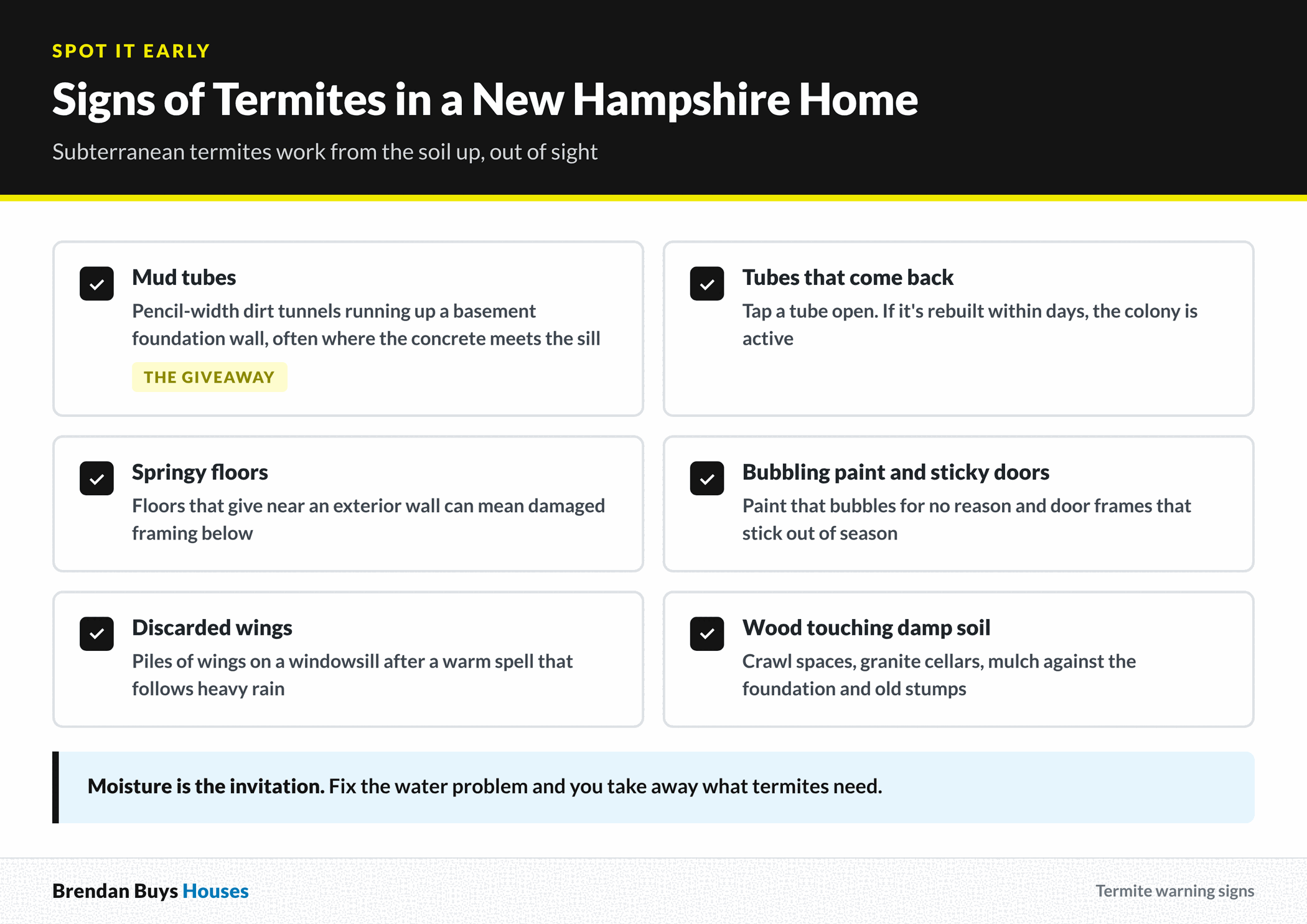
Mud tubes are the giveaway. Pencil-width tunnels of dirt and saliva running up a foundation wall in the basement, usually in a corner where the concrete meets the sill. The insects build them to stay moist while they travel between the earth and your framing, so tapping a tube tells you a lot. If it’s active, it gets rebuilt within days.
Some clues are quieter. Floors that feel springy near an exterior wall. Paint that bubbles for no reason. Door frames that stick in a season when they shouldn’t. Discarded wings piled on a windowsill after a warm spell following heavy rain, which happens when a colony swarms and the reproductives shed.
Crawl spaces, old granite cellars, the back of the garage where the mulch piles against the foundation, the spot where a tree stump was never ground out. Termites need a food source and moisture, and those two things sit together in a lot of older Manchester and Concord housing stock I’ve walked through.
Drywood termites get mentioned in national articles about a termite bond, but they’re a southern problem and not something I’ve run into up here. Our climate limits what survives. What I do see constantly in New Hampshire basements is carpenter ant damage, sometimes mistaken for termites. It is sometimes paired with a rodent or mice issue that signals the same underlying problem: water getting somewhere it shouldn’t. Fix the moisture and you remove the invitation.
Can You Sell a House with Termite Damage in New Hampshire?
For years I assumed visible insect damage would tank a sale outright, and I was wrong about that in a way that cost sellers money they didn’t need to spend.
You can sell a house with termite damage here. What you can’t do is hide it. The state’s disclosure rules are narrower than many states, so the statute covers specific categories like water supply, sewage, insulation, and radon, and there’s no single all-purpose property condition form mandated by state law. The practical limit is honesty. You may not have an affirmative duty to volunteer every defect a careful inspection would uncover, but you must answer a buyer’s questions truthfully, and fraudulent concealment isn’t permitted. The standard forms most brokerages there use ask directly about prior termite damage, treatment history, and known infestations. Once it’s on paper in front of you, your knowledge is on the hook.
A couple of years ago I bought a duplex from a longtime landlord in Rochester whose mother had just moved into assisted living. He’d found soft framing behind a basement workbench while clearing out her tools on a Saturday. He didn’t want a contractor, a treatment plan, or that kind of protection; he wanted one less thing on a list that already had twenty items on it. We bought it with the damage disclosed in writing and closed on his timeline.
Price adjusts for condition. Get one estimate before you negotiate so you’re arguing from a real figure.
Why Do New Hampshire Home Sales Require a Termite Bond?
Sitting at a kitchen table in Nashua last spring, I told a seller this, and I’ll say it here too. New Hampshire doesn’t have any law requiring a termite bond to sell a house. None. Not a state statute, not a municipal rule, not a condition of recording a deed.
So where does the pressure come from? Lenders and southern-transplant habits. A termite bond is standard practice across Georgia, Alabama, and the Carolinas, where termite pressure is relentless year round. Buyers relocating to New Hampshire from those markets bring the expectation with them and ask their agent for one.
Lender requirements are the other source, and those are real but limited. New Hampshire sits in the group of states where the VA asks for a pest inspection only when the appraiser spots evidence of wood-destroying insects in the appraisal report. VA’s own list doesn’t include New Hampshire, but a lender can still ask for an inspection, so the honest answer is to confirm with the specific lender on your sale rather than guess. The VA publishes its location-by-location rules, and you can check the current requirement on VA’s Wood-Destroying Insect Local Requirements page.
Notice what’s missing in all of that: a termite bond. An inspection report and that service agreement aren’t the same thing, because a lender asking for clearance wants a signed report showing no active infestation, not a multi-year service contract in your name.
Would you buy a warranty for a problem nobody has confirmed you have?
What Is a Termite Bond and How Does It Work?
“Isn’t that just a scare tactic the pest companies invented?” Partly, yes, in low-pressure markets like ours.
A termite bond is a service contract with a pest control company, renewed annually. The company commits to yearly inspections and to retreating at no extra charge if termites come back between visits, so you’re not stuck paying twice for the same problem. What separates a true bond from a plain warranty is the surety structure behind it, a financial reserve backing the company’s obligations.
Coverage splits into two tiers, and the difference matters more than the price. A retreatment-only bond pays for the extermination work if termites return but leaves every dollar of repair with you. A repair bond covers retreatment plus structural fixes up to a stated ceiling. You’ll want to check that number before assuming you’re protected. A repair bond capped low is a different product than its brochure suggests.
Most contracts bundle a few things together: an initial inspection and treatment, annual renewal visits by a licensed technician, retreatment coverage, and the documentation including the WDI report that real estate transactions call for.
A termite bond generates paperwork, and paperwork closes sales.
Bonds almost always require continuous renewal to stay alive, and a lapsed year can void the history you were counting on transferring. If a seller tells me the house has had a termite bond since 2019, I ask for every renewal receipt, not just the current one.
Standard homeowners policies exclude termite damage because insurers treat it as preventable maintenance rather than a sudden event.
Do I Need a Termite Bond to Sell My House in New Hampshire?
Buy one you don’t need and you’ve spent several hundred dollars that bought you nothing at the closing table.
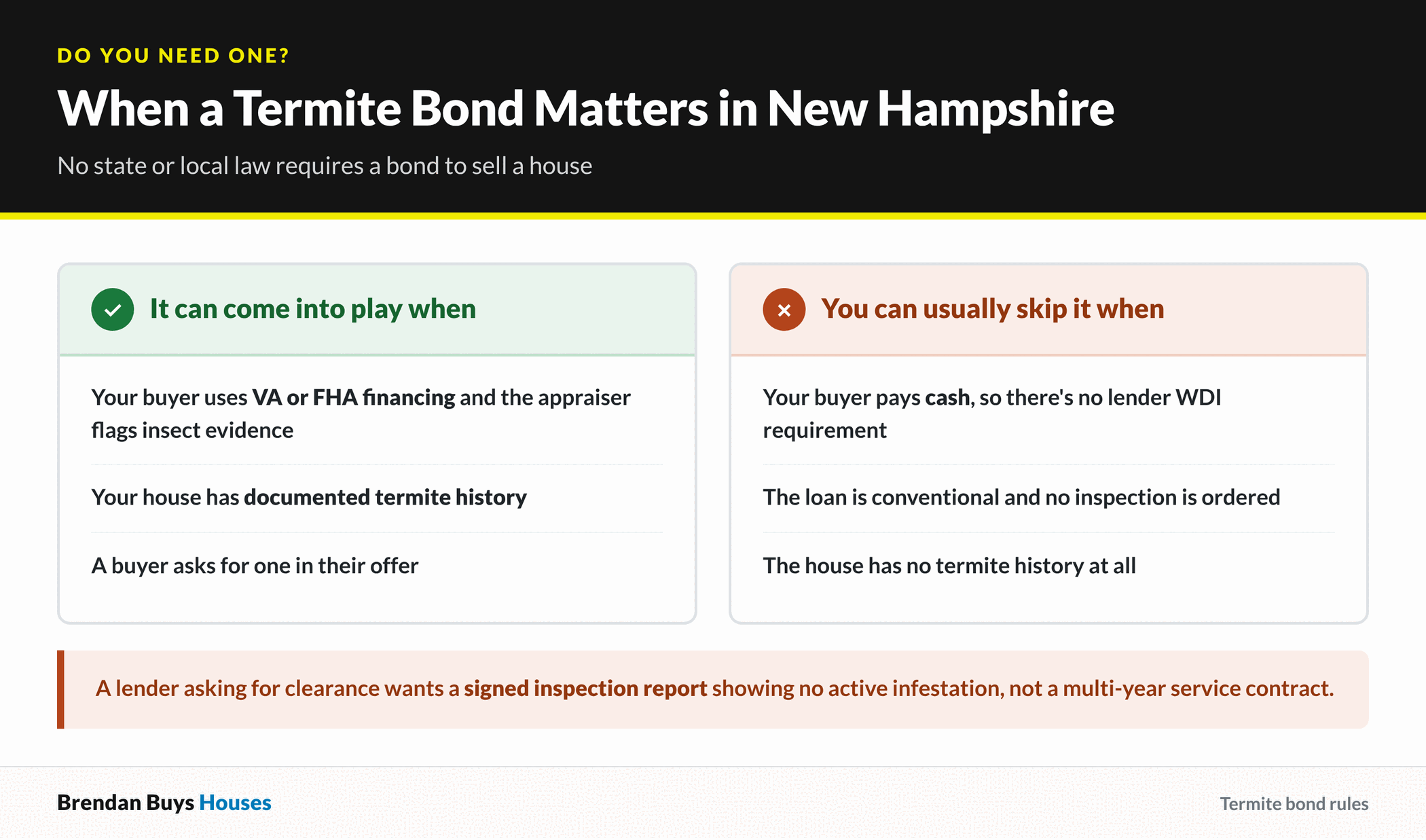
No, you don’t need a termite bond to sell a house in New Hampshire. Not as a matter of law, and not in the overwhelming majority of transactions I’m part of, so most sellers never give it a second thought. The question only turns live under a few specific conditions.
Condition one: your buyer uses VA or FHA financing and the appraiser flags insect evidence. Clearance becomes a closing condition at that point, though clearance usually means a treatment and a clean report rather than an ongoing termite bond.
Second condition: your house has documented termite history. Here a termite bond earns its keep. Transferring active coverage to the buyer answers the nervous question before it’s asked, and it’s cheaper than a price concession.
A buyer specifically demands one in their offer.
Cash buyers change the whole equation. There’s no lender WDI requirement on a cash sale, so the inspection, the clearance, and the termite bond all become optional. That’s a large slice of the New Hampshire market, particularly for older properties in Berlin, Claremont, and the North Country where financing gets complicated anyway. Investors like our team at Brendan Buys Houses do this daily without asking a seller for a single pest contract.
My plain opinion: buying a termite bond preemptively to make your New Hampshire listing more attractive is a waste. Southern sellers do it because their buyers want it that way. Ours don’t.
What Happens During a Termite Inspection Before Closing?
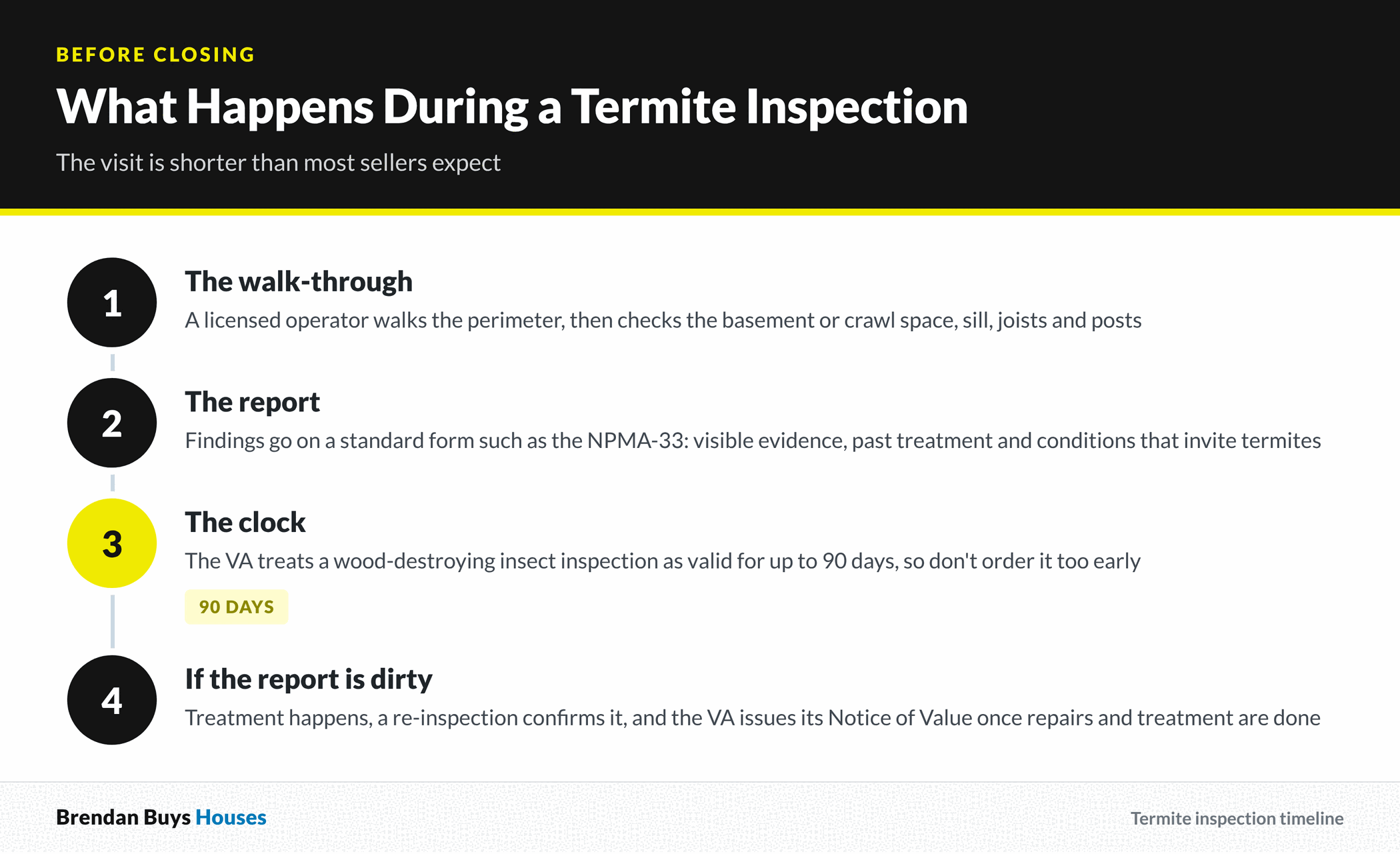
And if the inspection does get ordered, the visit itself is shorter than people brace for. A licensed operator walks the perimeter, drops into the basement or crawl space, probes accessible wood with a screwdriver, checks the sill, the joists, the posts, and any spot where soil touches framing. Garages and detached sheds often get included.
You’ll typically get a standardized form back. Most states require the report to be completed and signed by a licensed pest control operator on the NPMA-33 form issued by the National Pest Management Association or a state equivalent. It records visible evidence, prior treatment signs, and conditions conducive to infestation. That last category snags New Hampshire sellers more than live insects do: wood-to-soil contact, mulch heaped against the foundation, firewood piles stacked by the cellar door, a damp crawl space under foam insulation.
Mark your calendar carefully. The VA treats a wood-destroying insect inspection as valid for up to 90 days. Order one too early in a slow listing and you’ll be paying twice.
What happens if the report comes back dirty? The VA issues its Notice of Value only after all wood-destroying insect damage is repaired and any active infestation is treated. The sale doesn’t die but slows while a treatment happens and a re-inspection confirms it. Many pest companies will fold that treatment into a first-year termite bond, which is the most sensible moment to buy one.
Conventional financing is looser. Pest inspections aren’t automatic, and most New Hampshire conventional sales never involve a termite bond at all.
How Do You Get a Termite Bond Before Listing Your Home?
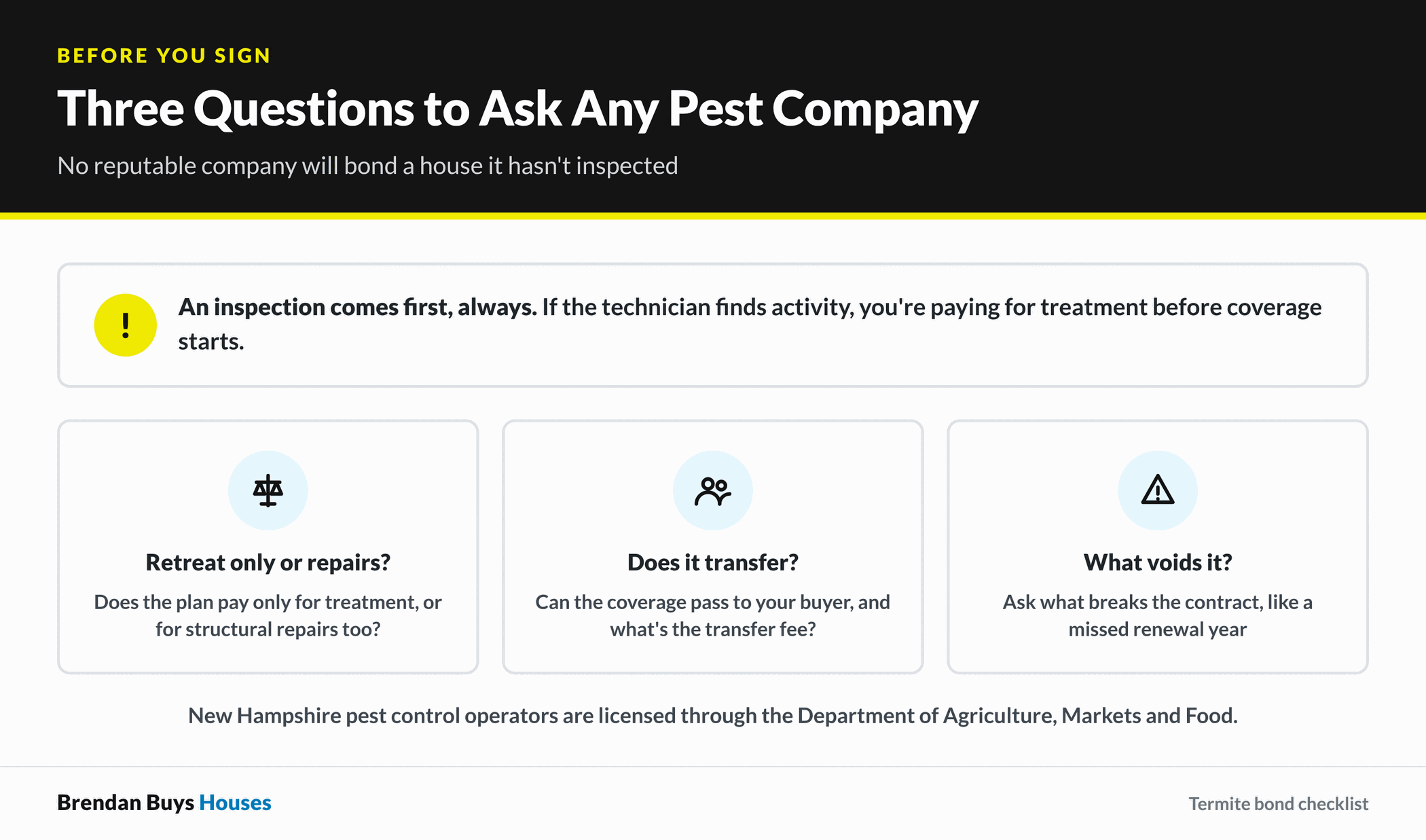
Call a pest company, pay a fee, get a certificate in the mail. That’s the picture in most sellers’ heads, and it falls apart at the first phone call, because no reputable operator will bond a house sight unseen. An inspection comes first, always, and if the technician finds activity you’re buying treatment before you’re buying coverage.
The sequence runs roughly like this. An inspection establishes baseline condition. Only then does the company write the termite bond, with the treatment date as the start of coverage.
Lead time is the catch. Baiting systems take months to work through a colony; field studies have documented subterranean termite activity eliminated often within three to six months. A seller who starts this in April to list in May has a problem.
Ask every company three questions before signing. Is this retreatment-only or does it include repairs? Does the coverage transfer to a buyer, and at what fee? What voids it?
New Hampshire’s pest control operators are licensed through the Department of Agriculture, Markets and Food, and verifying a license before you hand over a deposit takes one phone call.
Should you do any of this before listing? In most New Hampshire situations, no. I’d rather see a seller spend four hundred dollars grinding out the stump by the foundation and pulling the mulch back six inches. This is better than a preventive termite bond for a house with zero history.
How Much Does a Termite Bond Cost in New Hampshire?
A seller in Keene came to me with a quote for treatment plus coverage and a buyer threatening to walk. Two weeks later she’d closed, and she’d paid for none of it.
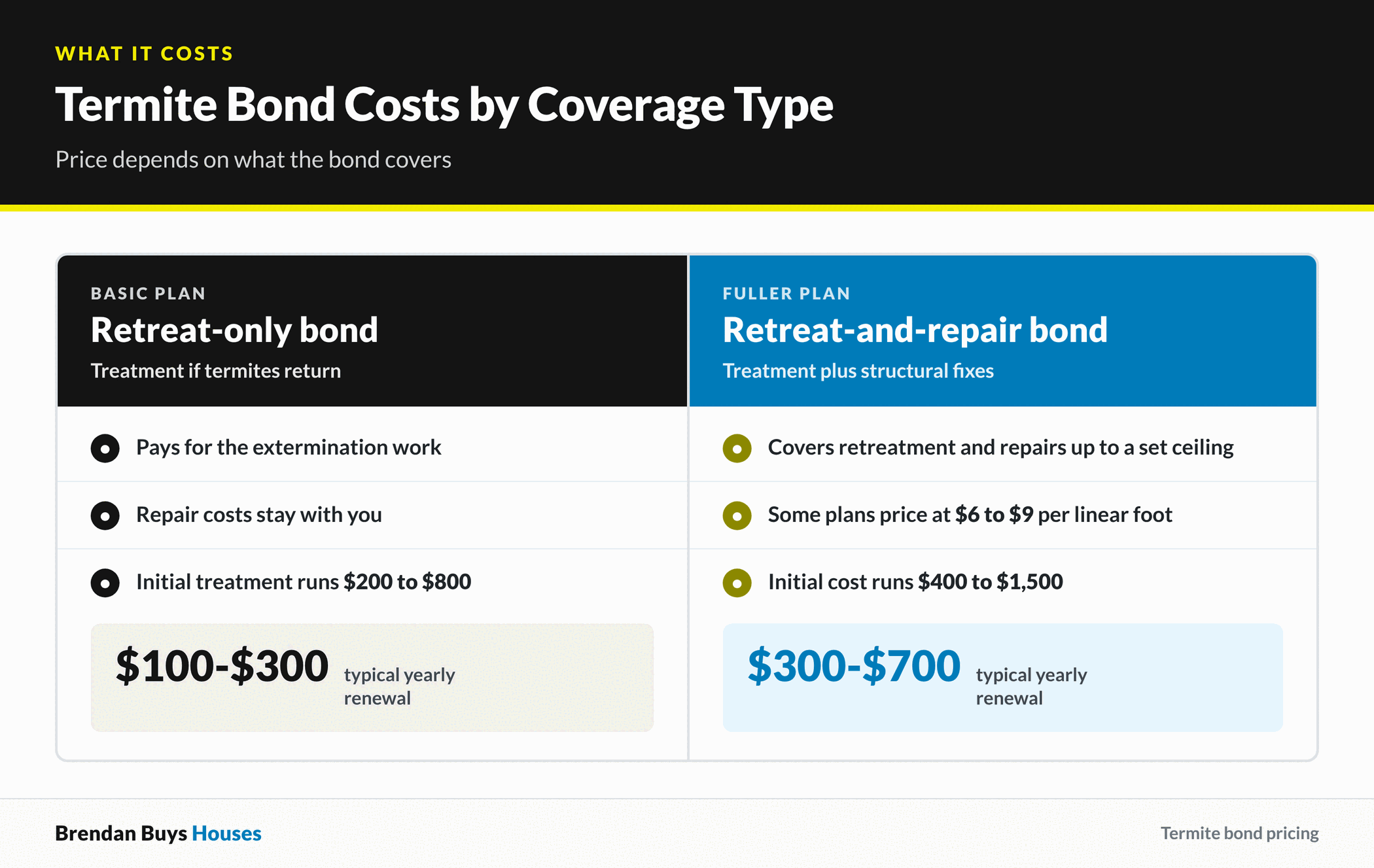
Pricing varies by what’s covered. Retreat-only bonds commonly renew in the range of $100 to $300 a year with initial treatment running $200 to $800; retreat-and-repair plans renew around $300 to $700 with initial costs from $400 to $1,500. HomeGuide’s compiled estimate puts termite contract renewal at $150 to $500 annually as of late 2025. Repair-coverage plans are sometimes quoted by the foot instead; retreat-and-repair warranties often price at $6 to $9 per linear foot of the structure’s perimeter.
NHAR’s September 2026 report put the statewide median single-family sale price at $569,900, up 6.5 percent year over year, with single-family homes going under contract in a median of 32 days. Against that price, a termite bond is a rounding error. Against a 32-day market, the weeks spent arranging treatment are the real cost.
Local numbers sharpen the point. Hillsborough County’s median single-family price in October reached $550,000, a 4.8 percent gain over the prior October, and Nashua homes averaged 19 days on the market that month. Sales here move faster than a bait system works.
A seller in Exeter I worked with was splitting assets in a divorce and wanted the house gone, not improved. We took it as it stood, garage contents included, and the lawyers got their number on schedule.
If a buyer insists on a termite bond, treat it as a line item in negotiation. Credit them the annual cost at closing and let them select their own company.
Frequently Asked Questions
Which States Does the VA Require a Termite Inspection In?
The VA bases this on regional termite risk rather than applying one national rule. A long list of southern and mid-Atlantic states need a wood-destroying insect report on every home loan. Several more require it only in certain counties. New Hampshire falls into the group where the trigger is the appraiser noticing evidence at the property. Your loan officer can pull the current requirement for your exact town before you spend anything.
What Does It Mean When a House Comes with a Termite Bond?
It means the sellers have an active service agreement with a pest control company covering inspections and retreatment, and that the house has usually been treated at some point. That history isn’t automatically bad news; a treated and monitored house can be in better shape than an untreated one nobody has ever looked at. Ask to see the original report and every renewal, then confirm the termite bond transfers to you and what that transfer costs.
Can Termites Ever Be Eliminated Completely?
A colony can be wiped out, yes, and professional treatment does that regularly. What you can’t eliminate is the possibility of a new colony finding your house later, since the soil around a New Hampshire foundation doesn’t stop being habitat after treatment. That’s the logic behind an ongoing termite bond and behind basic maintenance like keeping wood off the dirt and water away from the sill.
What Does a VA Termite Inspection Cost a Seller?
It’s one of the cheaper line items in any closing, typically landing in the same neighborhood as a standalone annual pest inspection rather than anywhere near a treatment bill. Who pays depends on your purchase agreement and local lender practice, so settle it in writing when the offer is negotiated. In New Hampshire the inspection often isn’t ordered at all unless the appraiser raises a flag.
Should I Buy a Termite Bond If My New Hampshire House Has No History of Termites?
Probably not. Without documented damage, a prior infestation, or a lender condition, you’re buying coverage for a risk your property hasn’t demonstrated, and no New Hampshire buyer is going to pay more for the certificate. Put the money toward moisture control in the basement instead, which addresses the condition that attracts insects in the first place.
If you’re staring down an inspection report, a termite bond quote, or a buyer who keeps adding conditions, and you’d rather just be done with the house, we’re glad to talk it through. We buy New Hampshire homes in whatever condition they’re in, damage disclosed and all, and we’ll tell you honestly if listing would serve you better. No pressure, no obligation, and no pest contract required.
The New Hampshire Market This Fall
New Hampshire REALTORS put the statewide single-family median at $543,223 for October 2026. That’s below September’s high, and homes still averaged about a month on the market. If a termite question is holding up your sale, the extra weeks can cost you more than any bond would.
Want to Sell Without Sorting Out a Termite Bond?
You can sell your house to us as it is, with any termite damage disclosed and no bond or treatment plan first. Contact Brendan Buys Houses with a few details about the property. You can also use the short form below to ask for a cash offer.
Helpful New Hampshire Blog Articles
- Selling a House With a Child Support Lien in New Hampshire
- How to Sell a Fire-Damaged House in New Hampshire
- Can Medical Bills Take Your House in New Hampshire
- What Happens to Your Homeowners Insurance When Selling a House
- Can I Sell My House and Still Live in It?
- Can I Sell My Parents House with Power of Attorney
- Should I Sell My House and Move to an Apartment
- Do You Need a Deed to Sell a House in New Hampshire
- Selling Investment Property in New Hampshire
- Do I Need a Termite Bond to Sell My House in New Hampshire
- How Soon After Chapter 7 Can I Sell My House
- How to Find a Realtor in Another State