


Most of the Maine homeowners who call me think the bank can take the house thirty days after a missed payment. It can’t. A foreclosure sale in Maine doesn’t happen the week after you fall behind, or even the month after. That belief is the costliest mistake I see, because panic makes people stop opening mail. You can still stop foreclosure in Maine at several points along the way, and your realistic options depend on exactly where you stand. The state builds in more protection than a lot of others do, but those protections run out on specific dates.
What Does the Foreclosure Process Look Like in Maine?
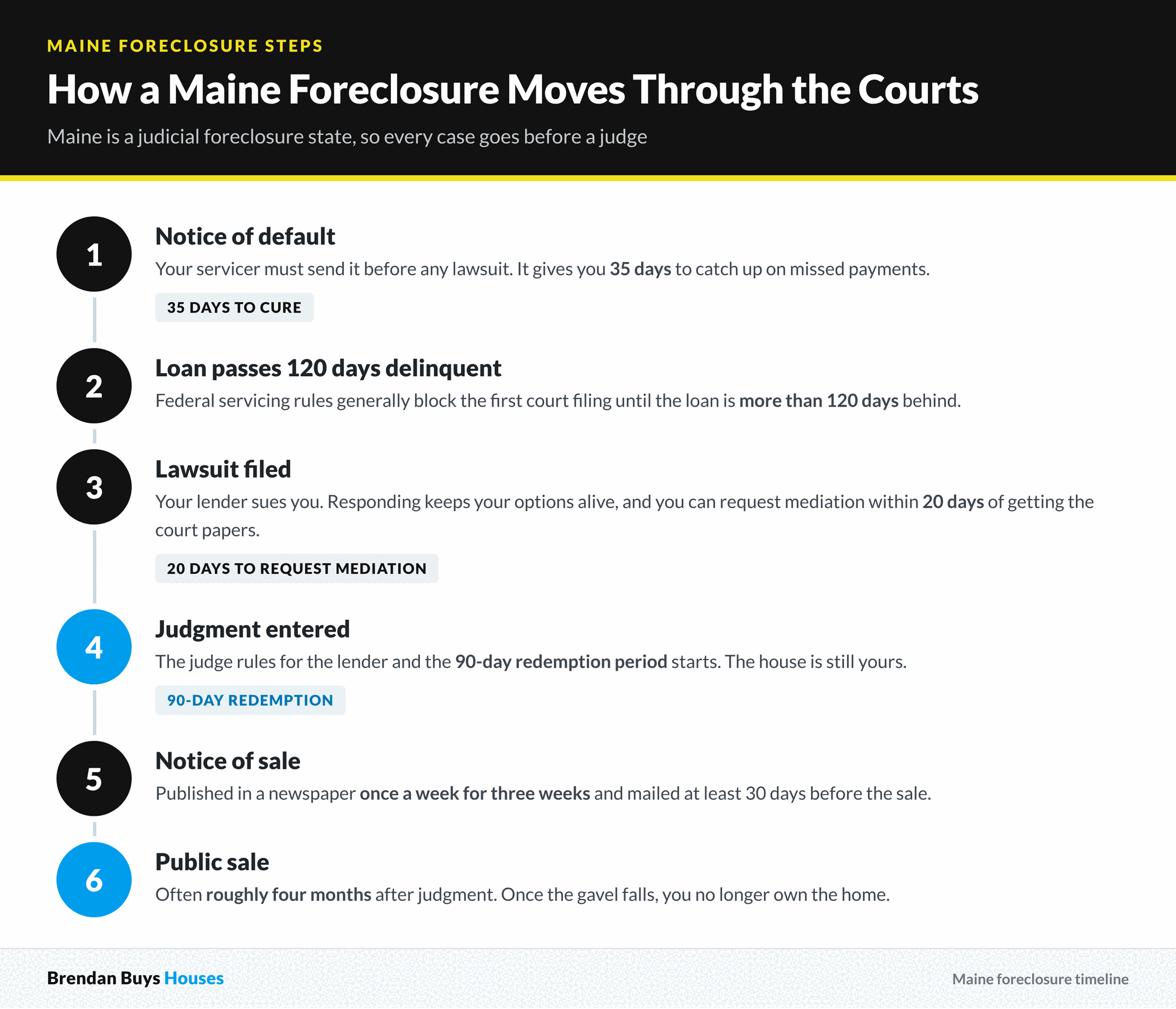
“Has the bank already started?” It’s usually the first thing people ask me, and the honest answer depends on what’s landed in the mailbox.
Maine is a judicial foreclosure state. Residential mortgages here get no power-of-sale shortcut, so your lender has to sue you, win a judgment from a judge, and hold a public sale once the redemption period runs out. A bank can’t tack a notice to the Cumberland County courthouse door and auction your house six weeks later.
First, though, the servicer has to mail you a notice of default before any complaint gets filed. That letter says you have 35 days to catch up on the missed payments and keep the foreclosure from moving forward, so the clock really does matter. Federal servicing rules stack another protection on top. A servicer generally can’t make the first court filing until the loan is more than 120 days delinquent.
The lawsuit comes next, and it’s where plenty of Maine homeowners lose ground without noticing. Tossing the papers in a drawer doesn’t buy time. It speeds the whole thing up, and answering them is what keeps your options open.
Maine’s courts offer one genuinely useful tool at this stage. Owners of a one-to-four-unit property in foreclosure can ask for mediation through the Foreclosure Diversion Program, and the Maine Judicial Branch’s foreclosure page explains how it works. You’re supposed to request mediation within 20 days of getting the court papers. Even after that window closes, the court still tells people to write to the clerk, since joining late may be possible.
Anyone hoping to stop foreclosure in Maine should guard that window closely.
How Much Time Do You Have Before Foreclosure Ends?
Homeowners in Maine tend to have more runway than they think. The trouble is they burn most of it waiting.
One rule sets your deadline more than any other. For mortgages signed on or after October 1, 1975, the redemption period is 90 days from the date of the judgment, under Title 14, §6322. That’s where Maine flips the usual order, putting the redemption period ahead of the sale. In most states you lose the house at auction and only then might get a chance to buy it back. Here, the window opens first.
After that period runs out, the bank runs a notice of sale in the newspaper once a week for three weeks. It also mails notice, at least 30 calendar days ahead of the sale, to everyone who appeared in the foreclosure action. All told, the home can be sold about four months after the judgment.
So the real question is which stage you’re in. Your chance to stop foreclosure in Maine looks different at every one of them.
Last year two grown children in Westbrook called me about their mother’s little cape. She’d moved into assisted living, and a judgment had already been entered. We closed inside that window, and the redemption period never ran out.
Add up the default notice, the federal delinquency rule, the lawsuit, mediation, and the post-judgment period, and a Maine foreclosure often runs most of a year. That’s real room to sell, refinance, or negotiate. The only choice that wastes it is doing nothing.
What Are Your Options to Stop Foreclosure Right Now?
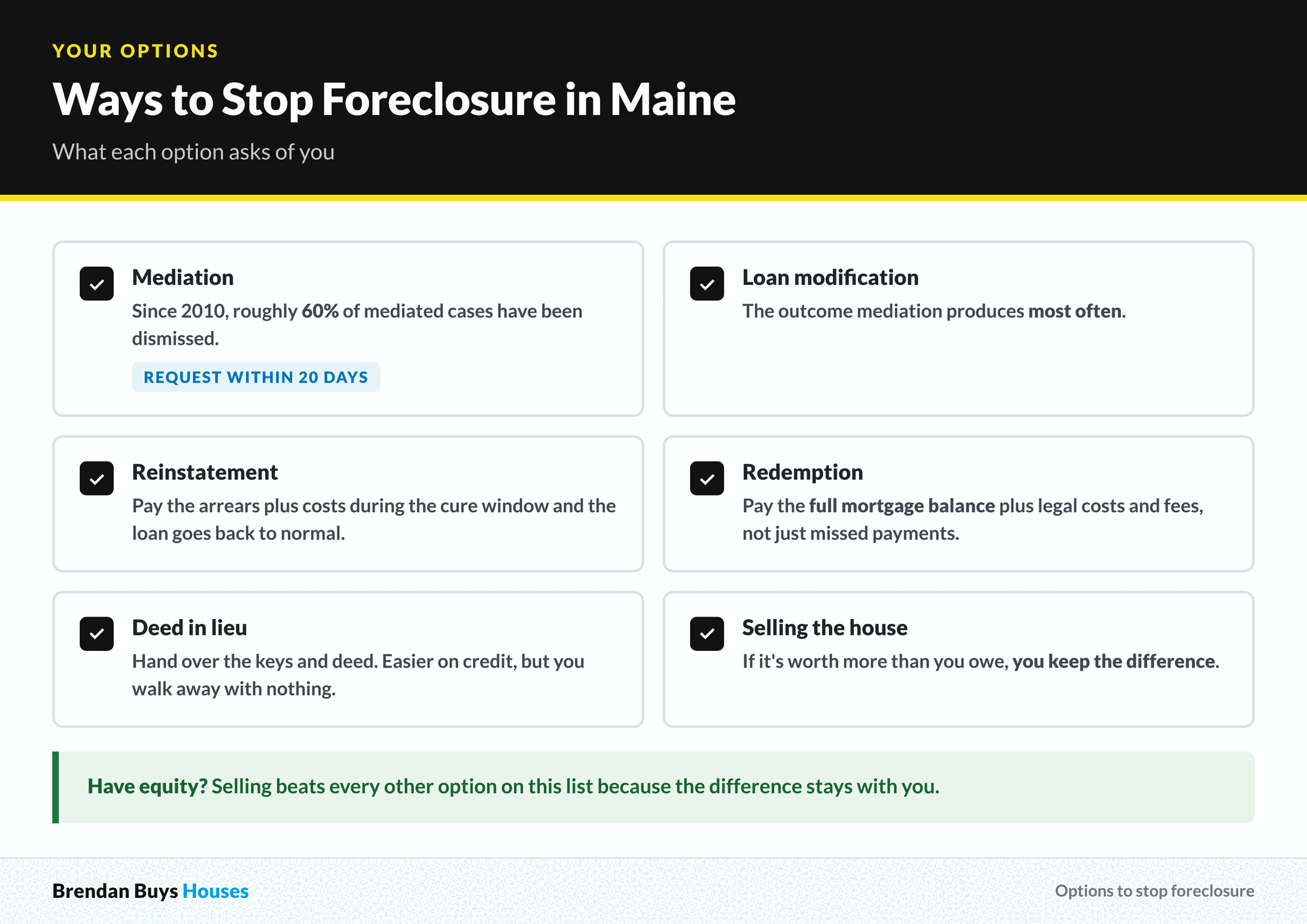
I used to think mediation was a box to check. The numbers changed my mind. Since Maine launched its foreclosure mediation program in 2010, roughly 60% of mediated cases have been dismissed, which means they ended with no foreclosure. Most of those families kept the house.
Mediation sessions cover real remedies. By rule, the program has to address reinstating the mortgage, modifying the loan, and restructuring the mortgage debt. A permanent loan modification is what most Maine borrowers want, and it’s also what mediation produces most often.
Reinstatement is the simplest fix. You pay the arrears plus costs while the cure window is open, and the loan goes back to normal.
Redemption is a much heavier lift. You’d need another source of financing to pay your lender the full mortgage balance plus legal costs and fees, not only the payments you missed. Maine’s own regulators spell this out on the Bureau of Consumer Credit Protection’s foreclosure page.
A deed in lieu runs the other direction. The lender gets the keys and the deed from you. Your credit takes less of a hit than it would with a completed foreclosure, though any equity you had walks out the door too.
Nobody at the courthouse will mention this, so I will. When your Maine home is worth more than you owe, selling beats everything else on this list, because the difference stays with you.
Selling is a perfectly legitimate way to stop foreclosure in Maine, and it’s the one I know best, since I buy houses from people in exactly this spot. If you want a straight answer on what your house is worth as-is, reach out to Brendan Buys Houses with no commitment.
Can Bankruptcy Stop a Foreclosure in Maine?
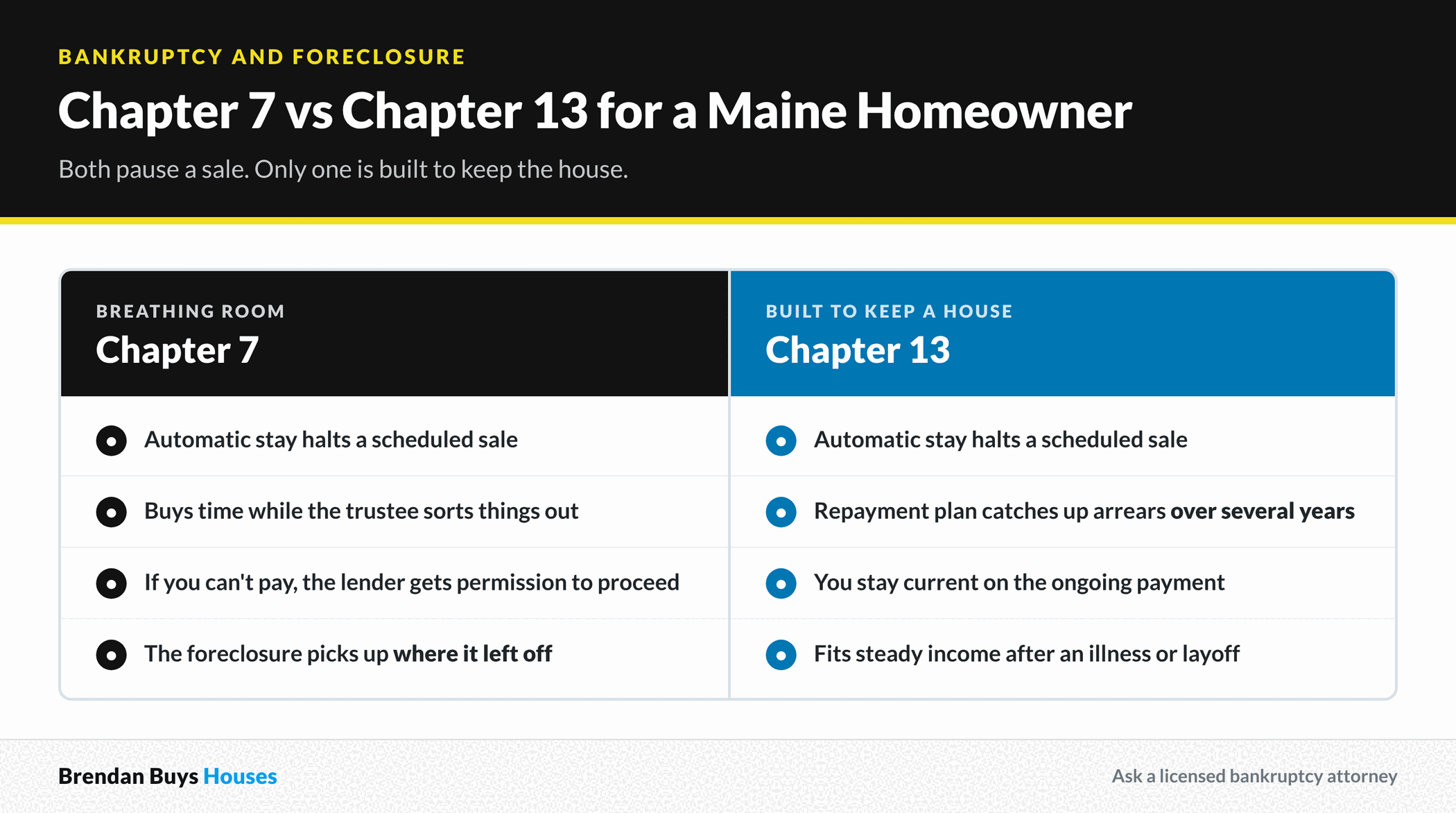
Yes, at least for a while. Filing triggers an automatic stay, which freezes collection activity, scheduled foreclosure sales included. It’s also not a cure. A Chapter 7 filing usually buys some breathing room while the trustee sorts things out. If you still can’t make the mortgage payment, the lender eventually gets permission to go ahead, and the Maine foreclosure picks up where it left off.
Chapter 13 is the version designed for keeping a house. You propose a plan that catches up the arrears over several years while you keep paying the regular mortgage. A Maine homeowner with steady income who fell behind after an illness or a layoff can do well with it.
The catch is the math, and lots of filers never run it. Six months in, they find the plan payment plus the regular mortgage payment is more than they take home, and the case gets dismissed.
Honestly, I’d rather watch a Maine homeowner sell a house with equity and keep their credit than file a Chapter 13 they can’t keep up with.
Say you’re three weeks out from an auction with a signed purchase contract that needs another month to close. An attorney can tell you whether filing would protect that sale. Only a licensed bankruptcy attorney is qualified to answer questions about your specific Maine case. Pine Tree Legal Assistance and HUD-approved housing counselors around Maine can point you to free help first.
Bankruptcy can stop foreclosure in Maine. Whether it’s the right move is a different conversation.
Does Selling Before Auction Stop Foreclosure in Maine?
“Nobody’s going to buy a house that’s already in foreclosure.” I hear it all the time, and it’s flat wrong.
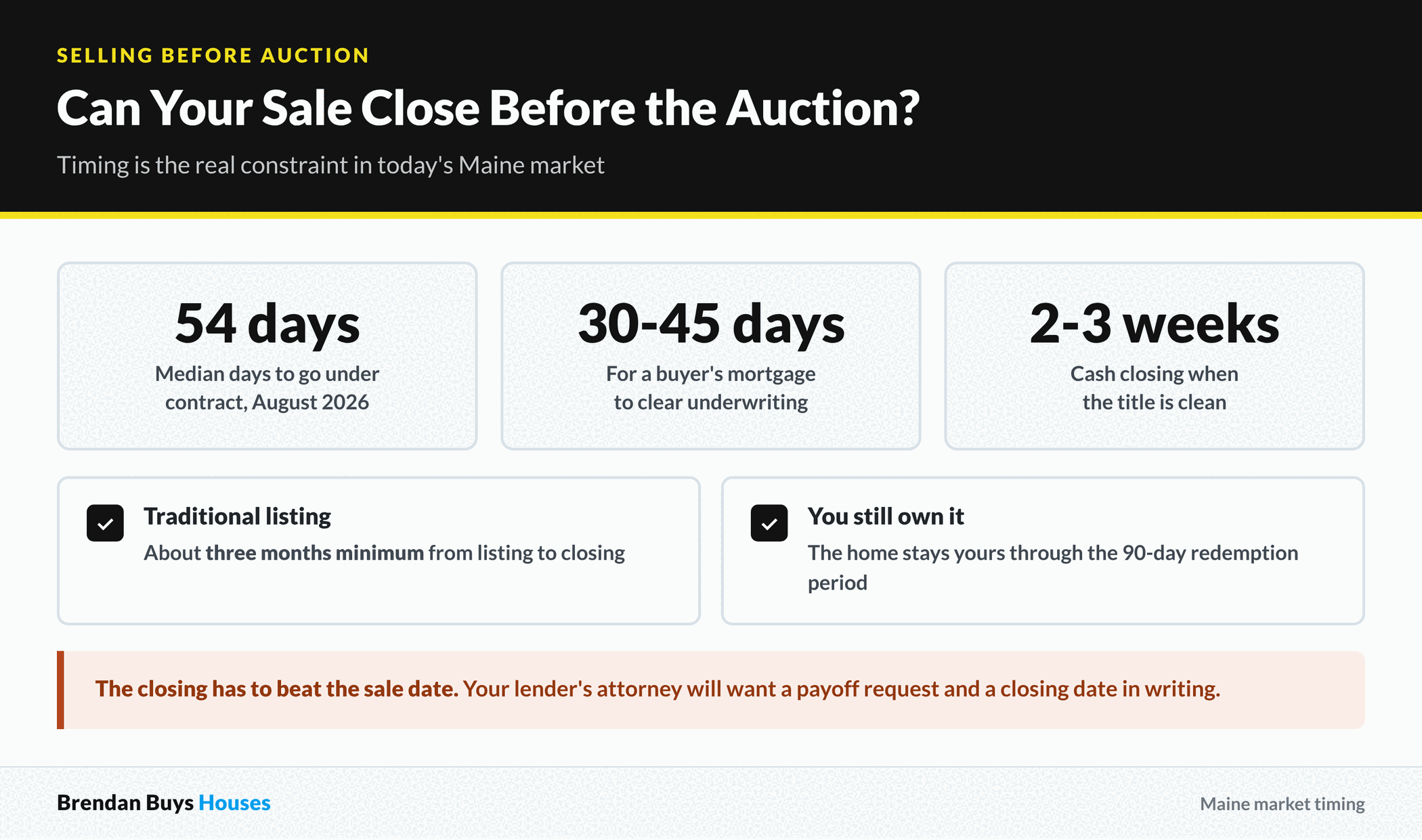
The home stays yours the whole way through, including the full 90-day redemption period.
Timing is the real constraint, and the current Maine market deserves an honest look. Buyers closed on 1,547 Maine homes in October 2026, down 6.6% from a year earlier. The median sales price slipped 5.6% to $402,500, according to the Maine Association of Realtors. Its 2026 president said buyers statewide have more homes to pick from and more room to negotiate, while sellers face stiffer competition from other listings. A softening market with more inventory makes selling on a deadline harder.
In August 2026, Maine listings took a median of 54 days to go under contract, and that isn’t the same as days to cash. Add 30 to 45 days for a buyer’s mortgage to clear underwriting, and you’re looking at three months minimum from listing to closing. If your judgment came down sixty days ago, a traditional listing won’t wrap up in time to stop foreclosure in Maine.
Sellers often miss this step. Your lender’s attorney will want a payoff request and a closing date in writing. Selling before auction absolutely does stop foreclosure in Maine, as long as the closing beats the sale date.
When Is It Too Late to Stop Foreclosure in Maine?
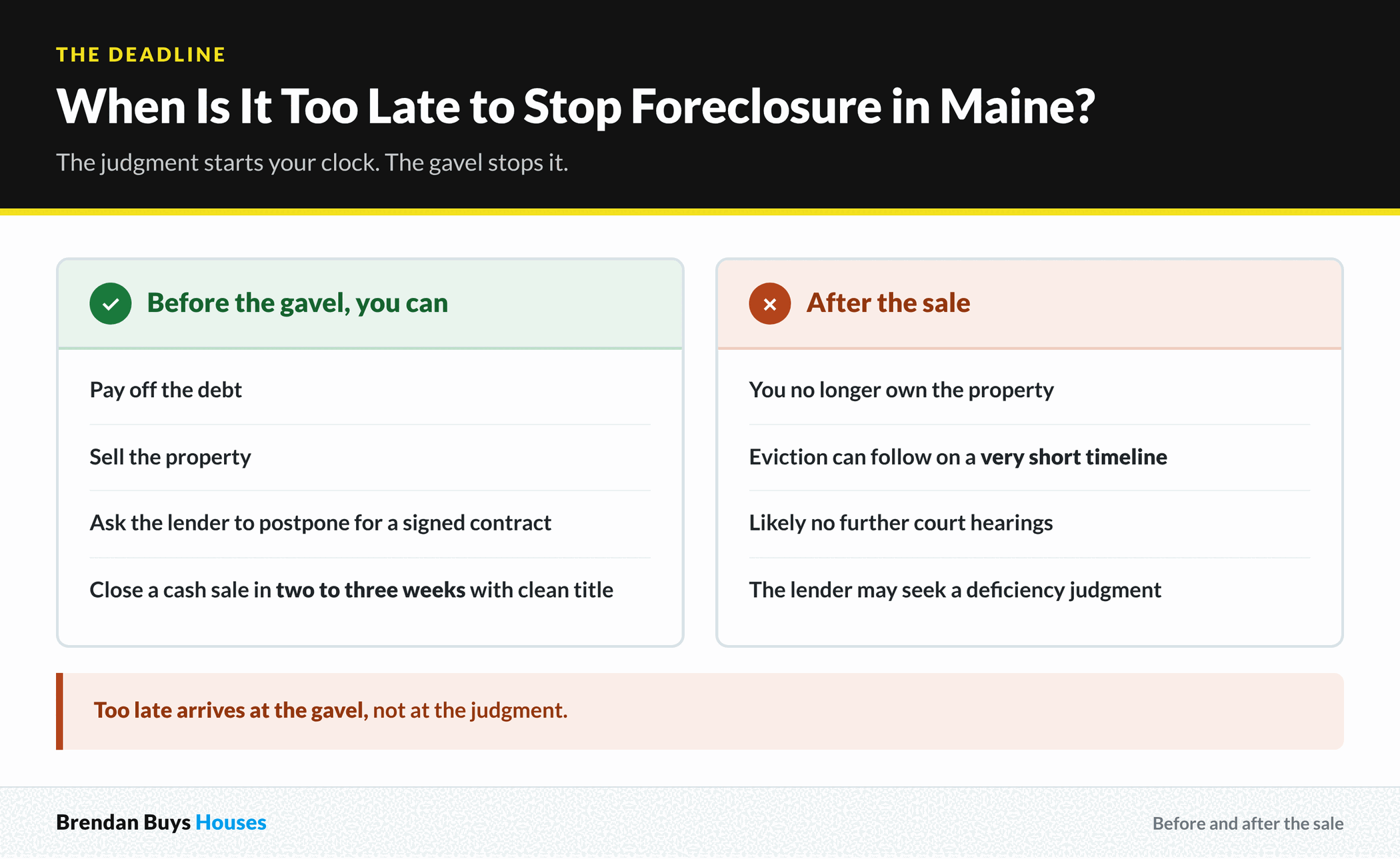
Lots of Maine homeowners treat the judgment like the end of the road and start packing. They’ve got it backwards. The judgment starts your redemption clock instead of closing it, and that 90-day period begins on the date the court enters judgment, as long as nobody appeals.
Right up until the auctioneer is done, you still have standing to pay off the debt or sell the property.
Once the sale happens, the door shuts hard. Miss the redemption period and you no longer own the property. The lender can evict you on a very short timeline, likely with no more court hearings, and Maine law hands the lender possession no matter the season or how much you still owed.
If you want the honest answer to when it’s too late to stop foreclosure in Maine, it’s this: too late arrives at the gavel, not at the judgment.
With a sale date already on the calendar, you likely have fewer weeks than you’d want. You still have some. A cash closing can wrap up in two to three weeks when the title is clean. A refinance can’t move that fast, and in this market a traditional listing in Yarmouth or Bangor can’t either.
For what it’s worth, foreclosures are still fairly rare here. Maine logged 136 foreclosure filings across 751,876 housing units in August 2026, or one in every 5,529 homes, well below the national pace that month. You’re not part of some crowd.
What Happens If You Can’t Stop Foreclosure in Time?
A seller in Lewiston called me ten days before his auction. He had a two-family he’d owned since the nineties, a tenant upstairs, and one big worry about what would happen if the clock ran out.
Sometimes a foreclosure sale on a Maine home won’t cover the full mortgage debt. When it falls short, the lender can pursue a deficiency judgment for the shortfall in many circumstances. That’s a personal debt that follows you after the house is gone, so ask an attorney about it before you decide to let an auction happen.
Eviction moves quickly once the redemption window closes. Maine law doesn’t give you a long goodbye or a winter grace period.
Surplus funds matter, too. When the auction brings in more than the debt and costs, the extra is yours, not the bank’s. Bidders at a Maine foreclosure sale buy sight-unseen with no inspection, and their prices reflect that risk. Selling on the open market or to a direct buyer will almost always net you more than watching your house get hammered down on a courthouse step.
Statewide, buyers haven’t disappeared, whether your house is near Portland or you’re looking for cash home buyers in Bangor. Redfin put Maine’s median sale price at $421,190 in September 2026, up 2.7% year over year. Equity that’s real today vanishes at auction. The version of this story I hate most is a sale that happens when the owner had sixty days and a house buyers wanted.
If you truly can’t stop foreclosure in Maine, ask the lender about cash for keys. It sometimes covers moving money and gives you a dignified way out. The worst they can say is no.
Frequently Asked Questions
Can You Get an Extension on a Foreclosure?
Sort of, though not by simply asking the court for more time. Your lender can agree to postpone a scheduled sale, and that happens regularly when a signed purchase contract or an approved modification is in the works. If a mediation session doesn’t work out, you and your lender can also jointly ask the court to pause the case while you keep working on an alternative. A bankruptcy filing halts a sale immediately, though it’s a serious step with lasting consequences, so talk to an attorney before you treat it as an extension.
How Long Do I Have to Move Out After the Sale?
Not long, and it’s the part that catches people off guard most. When your redemption window closes without a payoff, you’ve lost ownership, and Maine law lets the lender take possession on a very tight schedule with no further hearings expected. Weather, holidays, and the equity you had don’t change that. If an auction is coming and you haven’t found a way to stop foreclosure in Maine, start lining up housing now instead of after.
Can I Sell If I Owe More Than the House Is Worth?
Yes, through a short sale, where your lender agrees to accept less than the full balance. It takes longer than a normal closing because the servicer has to sign off on the price, and approval timelines vary by lender. Bring in a housing counselor or an experienced agent early, and be realistic about whether that timeline fits your deadline. Sometimes a deed in lieu is the faster, cleaner exit.
What If the Foreclosure Paperwork Has a Mistake in It?
Mistakes in default notices have sunk real cases in Maine, so have someone qualified read everything you got. The cure notice has strict content requirements, and a defective one can get a complaint thrown out. I wouldn’t count on a technicality. I would let a foreclosure defense attorney or a legal aid lawyer review the file before giving up on the house.
Facing a Foreclosure Date in Maine?
A judgment, a sale notice, or a pile of unopened letters can make it feel like the road has ended. Usually it hasn’t. We buy Maine houses in any condition, and we’ll be honest with you if listing would net you more. Contact Brendan Buys Houses or fill out the form below to get a fair cash offer with no obligation.
Helpful Maine Blog Articles
- Selling Home with Reverse Mortgage in Maine
- How to Sell a House With Mold in Maine
- Selling a House with Delinquent Property Taxes in Maine
- Can You Sell Your House With a Quitclaim Deed in Maine?
- Is the Seller Responsible for Any Repairs After Closing in Maine?
- Selling a House with Unpermitted Work in Maine
- Can I Sell My House If I’m Behind on Payments in Maine
- Selling a House With Foundation Problems in Maine
- Can You Sell a House With Termites in Maine
- Documents Needed to Sell a House in Maine
- How Late Is Too Late to Stop Foreclosure on Your Maine Home