


A deed with one signature can sit in the registry for years and look perfectly fine. Then a title examiner pulls it, notices a spouse is missing, and the closing stops cold. We buy houses across New Hampshire, and the title snag we encounter most often isn’t a lien or an old mortgage. It’s a husband or wife who never signed. If you’re asking whether spousal consent is legally required before your home changes hands in New Hampshire, the short answer is that it usually is. The longer answer takes about ten minutes, and it’s worth them.
Does New Hampshire Require Spousal Consent to Sell a House?
Skip that signature and you may not have sold anything. A deed that doesn’t release the homestead right won’t cleanly transfer what the buyer thinks they’re getting, and untangling it later eats real money in attorney time. Title companies in New Hampshire catch most of these before closing. The few that slip through become quiet claims nobody wants.
New Hampshire isn’t a community property state. Each spouse owns whatever is titled in their name unless the deed says otherwise, so who holds the real estate comes down to how title reads. Buying property during a marriage here doesn’t make it jointly owned automatically.
If one person holds title alone, why should spousal consent matter at all?
It matters because of the homestead right. Under RSA 480:5-a, no deed conveys or encumbers the homestead right unless the owner and the owner’s spouse, if any, both execute it with the formalities required for conveying land. The single exception is a mortgage you signed to cover the purchase price when you bought, so nearly every other transaction needs both names. The protection attaches to a primary residence on its own and covers the titled owner plus any non-titled spouse, with no filing or paperwork required.
Last year I helped three siblings in Goffstown whose mother had just moved into assisted living. Only her name was on the deed. Her husband’s wasn’t, and the family figured that settled it. We wound up getting his release signed one Tuesday afternoon at the facility before the closing could move forward. Nobody had done anything wrong. The paperwork simply had to be right.
New Hampshire’s standard warranty deed form already plans for this. The RSA 477:27 warranty deed has a built-in line where the spouse releases all rights of homestead and other interests to the grantee.
What New Hampshire Law Says About Spousal Consent and Home Sales
“My wife’s name isn’t on the mortgage, and the bank never asked her for anything.” I hear some version of that all the time, and it misreads what the homestead statute protects. Lending papers and ownership papers follow different rules. The homestead right has nothing to do with who borrowed the money. It’s about who lives in the house as a married person.
Chapter 480 of New Hampshire’s statutes sets out the whole framework. Two provisions carry most of the weight. Under RSA 480:3-a, the owner and the owner’s husband or wife are both entitled to occupy the homestead right during the owner’s lifetime. RSA 480:1 puts a dollar value on that right. Currently sitting at $120,000 per person, it’s no small number.
That figure carries more weight at today’s prices. New Hampshire Association of Realtors data put New Hampshire’s median single-family home price at $543,223 in October 2026. A homestead claim covers only a slice of that, yet it’s plenty to wreck a closing statement.
Courts don’t treat this as a technicality. The New Hampshire Supreme Court has ruled that the homestead right under RSA 480:1 came ahead of a creditor’s equitable lien. That creditor had real money on the line and still lost to the homestead right.
Trusts tangle up spousal consent in ways that surprise even experienced sellers, and I’ve watched them derail closings that otherwise looked clean. A deed to the trustees of a revocable trust doesn’t strip the signer’s homestead rights unless the deed expressly releases them. Families who put their New Hampshire property in a living trust ten years ago often need the non-titled spouse to sign again on the way out.
Can My Spouse Sell Our House Without My Consent in New Hampshire?
“Can he just list it and sign all the paperwork himself?”
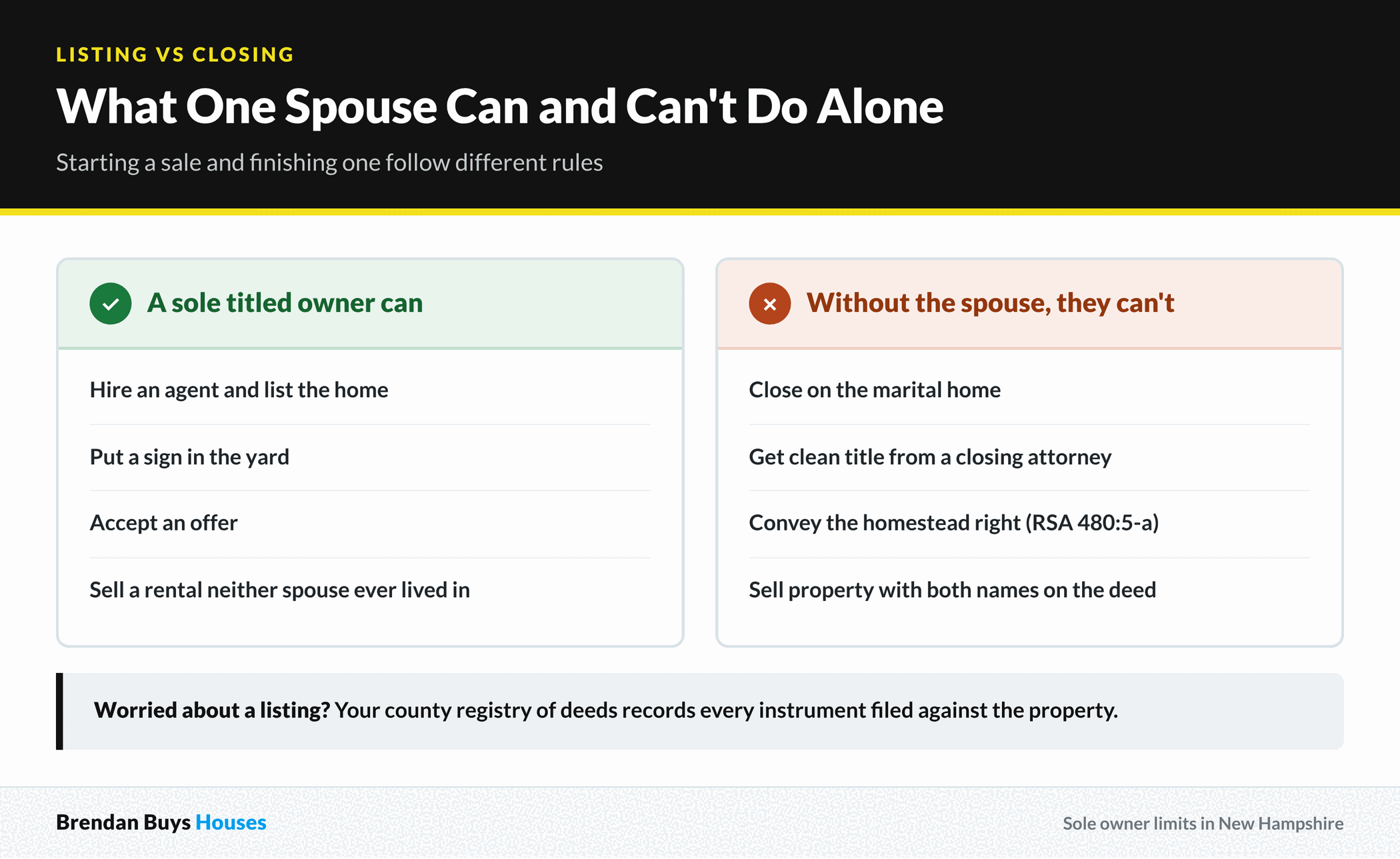
He can list it. Nothing stops a sole titled owner from hiring an agent, planting a sign in the yard, and accepting an offer. Closing it without spousal consent is where the wheels come off. Any competent New Hampshire closing attorney will ask for the spouse’s release before funding, and most won’t issue clean title without it.
Listing a house is one thing, and closing on it is another. If you’ve just learned your spouse listed the marital home behind your back, check the registry of deeds in your county, which records every instrument filed against the property. A quick search shows what’s actually happened so far.
Property held jointly makes spousal consent even simpler. Two names on the deed means two signatures, period, because neither owner can convey the other’s interest. Joint tenancy with rights of survivorship or tenancy in common, it makes no difference here. A seller can only convey what they actually own.
Investment property plays by different rules than the place you live. Picture a rental duplex in Manchester that neither of you has ever lived in. It carries no homestead right, so a spouse who holds title alone can sell it alone. Marital property claims in a divorce still exist separately.
Speed raises the stakes, too. NHAR’s report had New Hampshire single-family homes moving in a median of 32 days in September 2026. A month on the market plus a closing period leaves a left-out spouse very little time to react, so check the registry early instead of finding out at the eleventh hour.
How Homestead Rights Affect Spousal Consent in New Hampshire
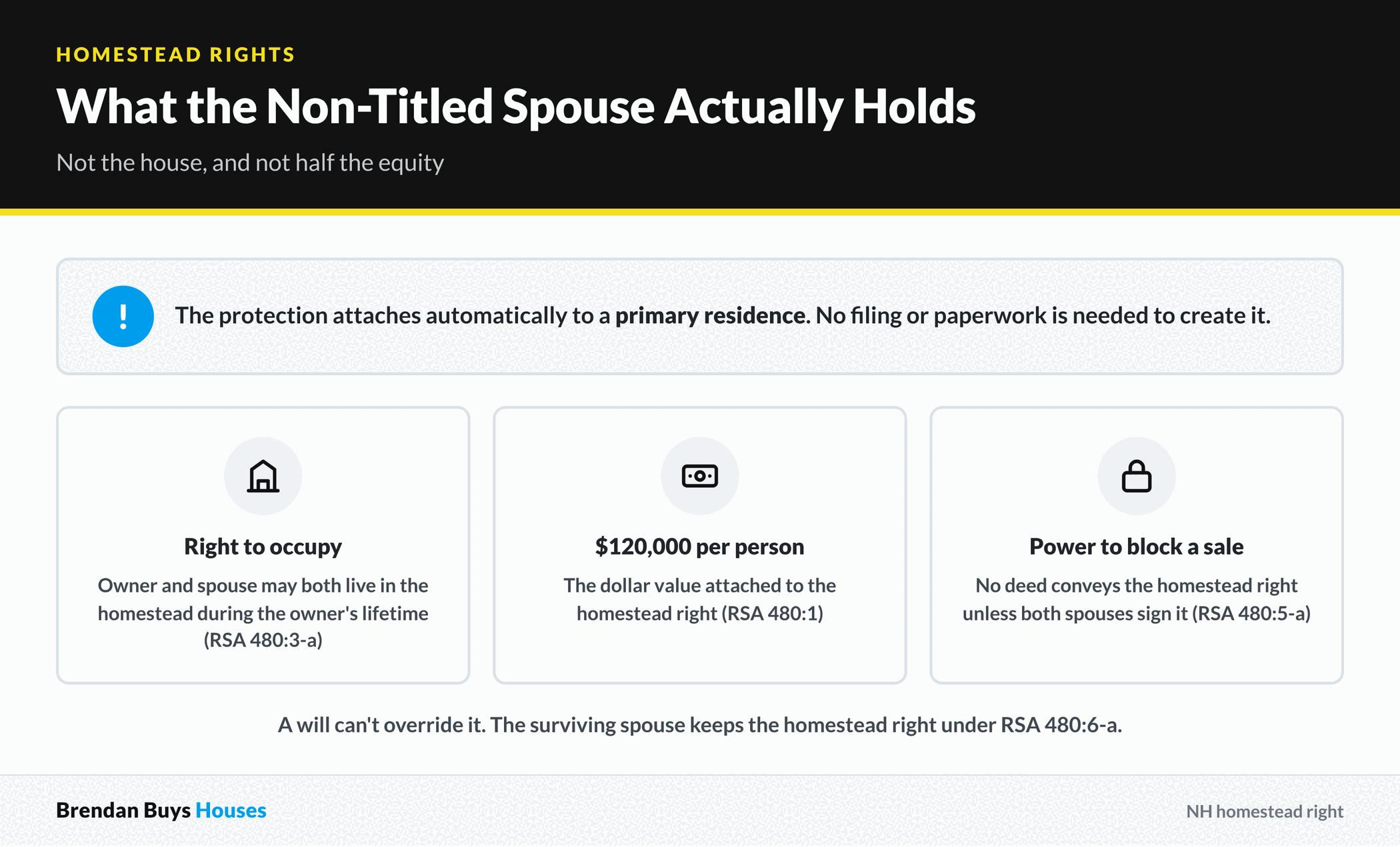
That leads to the question I hear next, which is what the non-titled spouse actually owns. The answer isn’t the house, and it isn’t half the equity. What they hold is a right to occupy, a dollar exemption, and the statutory power to block a conveyance by refusing to sign. Put together, that’s stronger than it sounds.
Lenders found this out the hard way. If a lender truly expects the homestead to be waived, every spouse has to sign the homestead waiver, and the formalities include a signature acknowledged before a justice, notary public, or commissioner.
I’ve sat through enough closings to have an opinion. The homestead rule is good law, and the people who complain about it are usually the ones who tried to cut a corner.
Death doesn’t wipe out spousal consent protections, either. Under RSA 480:6-a, a devise of the homestead can’t touch the surviving husband’s or wife’s estate in the homestead right. You can’t will your way around your spouse.
Older New Hampshire couples show me this pattern again and again. One spouse runs the finances, signs everything, and honestly believes they can sell because they always have. Then the title company sends a homestead release, and the other spouse can’t figure out why their signature suddenly matters after forty years of not mattering.
Where the property sits changes the stakes. Rockingham County led New Hampshire with a $675,000 median single-family price in October 2026, driven largely by the Portsmouth Seacoast, where the median reached $875,000. A disputed signature on a Rye or North Hampton property puts far more on the table than one in Coos County.
When Is Spousal Consent Not Required to Sell Property in New Hampshire?
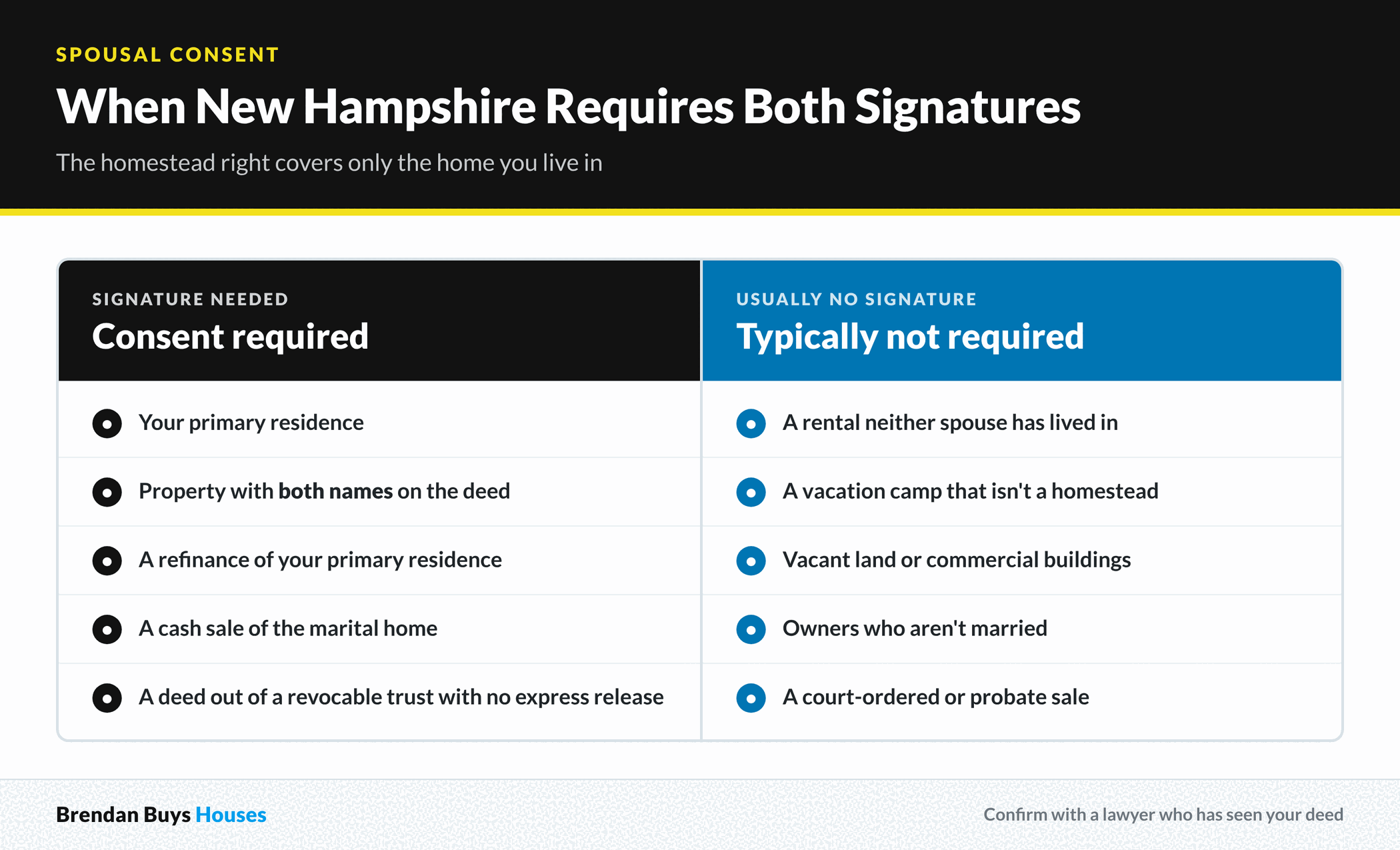
Plenty of homeowners read the statute and decide their spouse can veto every piece of real estate they own. In reality, the homestead right covers just one property: the one you live in as your primary residence. A camp on Winnipesaukee the family uses three weekends a summer generally isn’t a homestead, and neither is the Lebanon condo you rent to a Dartmouth grad student.
Unmarried owners can skip spousal consent entirely.
Vacant land, commercial buildings, and inherited parcels nobody lives in usually transfer from a sole owner without a second signature. Still, check with a lawyer who has read your actual deed instead of leaning on a general article, this one included. I’ve watched “it’s just a rental” turn out to be a property the spouse had lived in for two years.
Probate sales run on their own machinery. When an estate sells real estate with the court’s authority, the fiduciary’s power flows from the probate process rather than from a spouse’s signature.
Court orders can override spousal consent requirements, too. A judge in a divorce can order a sale and authorize one party to sign, or appoint someone to sign for a spouse who refuses. Stonewalling a property division forever and expecting the court to shrug won’t work.
Selling a non-homestead property without telling your spouse is often legal, and it’s still a bad idea. New Hampshire divorce courts look at the full financial picture, and quiet transfers tend to get a close look.
Can Spousal Consent Be Waived or Lost in New Hampshire?
I spent years assuming a signed purchase agreement locked in spousal consent. It doesn’t. Executed with the proper formalities, the release must be present in the deed itself, or the homestead right travels along to the new owner.
When husband and wife both execute a mortgage with the formalities required for conveying land, that waives the right as to that mortgage. New Hampshire Title Standard 5-5 covers homestead release with revocable trusts and confirms that a deed to a trustee doesn’t release the grantor’s homestead rights without an express release in the form.
Filing for divorce pushes the other way, limiting what either spouse can do. Under RSA 458:16-b, the court issues an order as soon as a case is filed. That order bars each party from selling, transferring, encumbering, hypothecating, concealing, or otherwise disposing of any property that belongs to either or both parties. There are exceptions for a written agreement of both parties, reasonable and necessary living expenses, and transactions in the ordinary and usual course of business. After a petition is filed, spousal consent stops being only a homestead question and becomes a court compliance question.
Abandonment and long absences show up in older New Hampshire cases, and how they turn out depends on facts I can’t predict for you. A real estate lawyer who pulls your deed history can give you a straight answer in one meeting. If you’re trying to sell with that kind of title cloud over the property, a buyer who handles these regularly makes life easier. Our team at Brendan Buys Houses has closed plenty of transactions where the paperwork needed untangling first.
Can one spouse sign a power of attorney letting the other release homestead? It depends on how the document is drafted, and generic forms pulled off the internet often fall short of what a title examiner wants.
What Happens Without Spousal Consent When There Is No Will
A widow called me about a three-bedroom ranch her husband had owned in his own name since before they married. He died without a will. His grown children were already asking about the house, and she had no clue whether she could sell it.
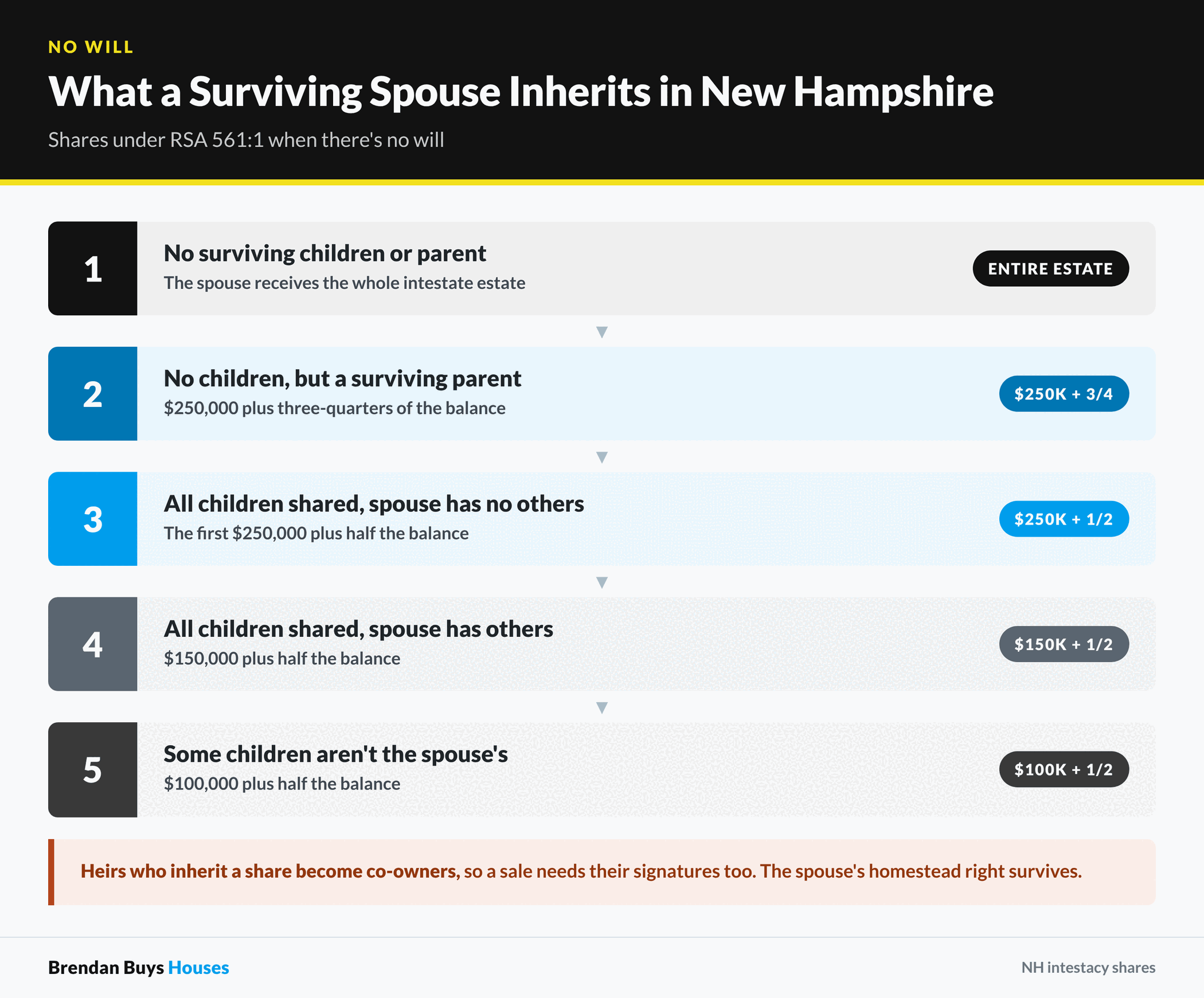
New Hampshire’s intestacy law settles that. Under RSA 561:1, a spouse takes everything when no children or parents survive. If any of the decedent’s children aren’t hers, she takes the first $100,000 plus half the balance. Other family situations land between those two, and every tier is in the statute on Justia.
Those stepchildren then co-own the house, so you’d need their signatures along with hers. Her homestead right stacks on top of that, since RSA 480:3-a lets a surviving spouse keep that right for life. New Hampshire’s probate courts work through these situations all the time. The circuit court also posts plain-language estate guidance that’s worth a read before you hire anyone.
Title trouble isn’t the only reason owners call me. A Claremont landlord reached out after the estimate for a new kitchen in his two-family came back higher than the value it would add. His tenant’s cat had already wrecked the back stairs. After eighteen years, he decided selling as-is beat sinking more cash into a unit he was tired of managing.
Sellers in a hurry get careless. NHAR puts statewide single-family sales through September 2026 at a $563,275 median with 31 days on market. Thirty-one days feels quick when you’re still waiting on a probate appointment. A listing wants everything settled by a fixed date, which is why some sellers in this spot pick a direct sale with a flexible closing.
Frequently Asked Questions
Does Spousal Consent Apply If My Name Was Never on the Mortgage?
Yes, and it catches more New Hampshire sellers off guard than anything else on this list. The homestead protection attaches because you’re married and the property is your primary residence, not because you signed loan paperwork. A lender’s records and a registry of deeds answer different questions entirely.
Is Spousal Consent Required for a Refinance?
Generally yes, for a primary residence in New Hampshire, since a refinance encumbers the homestead right the same way a sale conveys it. The exception for the loan that covered your purchase price doesn’t reach later loans. Your lender’s closing attorney will ask for the release, and skipping it leaves the lender in a weaker spot than it realizes.
What If We’re Separated but Not Divorced?
Being separated without a filed divorce action doesn’t change the homestead analysis, so spousal consent still covers the marital home. Once someone files, the automatic property restraining order kicks in on top of that. Years of living apart won’t quietly dissolve either protection.
Does Spousal Consent Matter for a Cash Sale?
A cash buyer still takes title through a deed, and that deed still has to release the homestead right. Paying cash speeds up financing contingencies. It doesn’t touch statutory requirements. Any experienced New Hampshire buyer will want the same signature a mortgage lender would.
The Manchester Market Right Now
Manchester homes kept moving quickly all summer. In August 2026 the city’s single-family median was $464,500, with less than a month of inventory on the market, according to New Hampshire REALTORS. A signature dispute can hold up a sale for weeks, and in a market that tight, buyers have plenty of other houses to look at.
Selling With a Spouse’s Signature in Question?
Missing releases and tangled titles shouldn’t leave you stuck. We buy New Hampshire houses as-is, and plenty of our closings start with paperwork that needs sorting out. Reach out to Brendan Buys Houses or fill out the form below for a fair cash offer with no obligation.
Helpful New Hampshire Blog Articles
- Selling a House With a Child Support Lien in New Hampshire
- How to Sell a Fire-Damaged House in New Hampshire
- Can Medical Bills Take Your House in New Hampshire
- What Happens to Your Homeowners Insurance When Selling a House
- Can I Sell My House and Still Live in It?
- Can I Sell My Parents House with Power of Attorney
- Should I Sell My House and Move to an Apartment
- Do You Need a Deed to Sell a House in New Hampshire
- Selling Investment Property in New Hampshire
- Do I Need a Termite Bond to Sell My House in New Hampshire
- How Soon After Chapter 7 Can I Sell My House
- How to Find a Realtor in Another State
- Can My Spouse Sell Our House Without My Consent in New Hampshire